
The silence that descended upon the courtroom was suffocating, heavy with the weight of unsaid truths and the sudden shift in power. Gavin’s face, usually a mask of practiced indifference, flickered with a raw, ugly confusion. He opened his mouth to retort, perhaps to cite the documentation his lawyers had spent months fabricating, but Helena simply waved a hand dismissively, as if swatting away a persistent fly. She turned her gaze back to me, her eyes searching my face with an intensity that felt like a long-lost embrace.
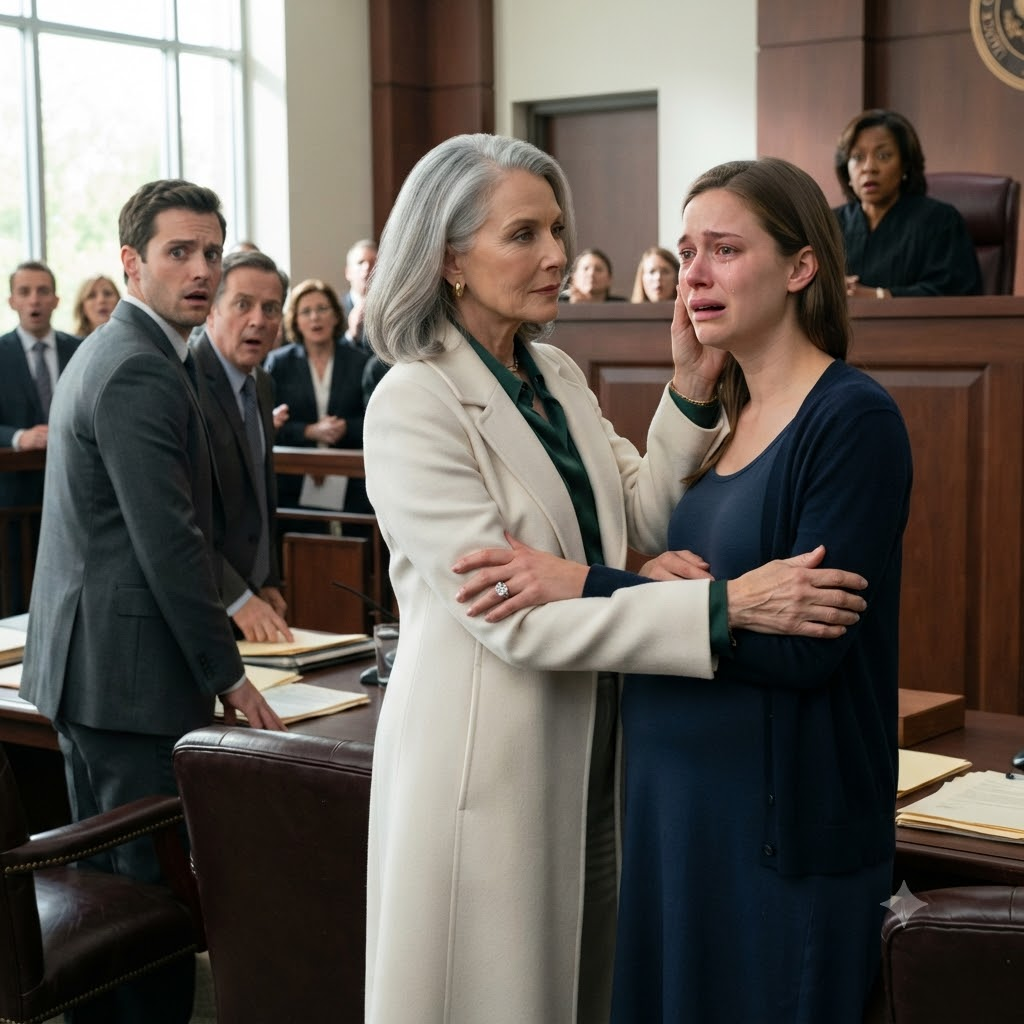
Outside, the city of London churned on, indifferent to the seismic shift occurring within these four walls. I felt dizzy, my mind grasping for purchase. I had spent twenty-five years believing I was an orphan, a ghost in the system with no lineage to anchor me to the earth. To be claimed—not just by anyone, but by a titan like Helena Ashford—was a prospect so overwhelming that my knees threatened to buckle.
“I need you to come with me, Nora,” Helena said, her voice dropping to a register only I could hear. “Everything you’ve been through, every ounce of grief you’ve held, it ends now. I have a car waiting. We are leaving.”
Gavin stepped forward, his bravado returning as he sensed the fragile nature of this new alliance. “Your Honor, this is preposterous. This woman is delusional, or she’s being misled. My wife—my estranged wife—has no ties to the Ashford estate. This is a theatrical distraction.”
Helena didn’t even turn around. She reached into her handbag, pulled out a heavy, cream-colored envelope, and placed it on the defense table. It didn’t land with a thud; it landed with the finality of a gavel. “You spent months digging through my archives, Gavin,” she said, her voice echoing in the quiet room. “You thought you were so clever, finding ways to funnel assets into shell companies. But while you were hiding money, you were accidentally stumbling into the history of the woman you tried to destroy. The DNA records in that envelope aren’t just a claim; they are a death warrant for your career.”
My heart hammered against my ribs. I looked at Amara, whose eyes were wide with a mixture of shock and dawning realization. Gavin’s face drained of color. He picked up the envelope, his fingers fumbling with the seal, and as he read the contents, his composure shattered entirely. The man who had spent hours detailing my supposed instability now looked like he was about to faint.
“How?” he rasped, his voice barely audible.
“You married her because you thought she was weak,” Helena said, finally looking at him, her gaze cold as polished steel. “You didn’t realize that the reason she was so good at building your business from nothing was that she possessed the same instinct for strategy that runs in our blood. You underestimated her, and in doing so, you handed me every piece of evidence I needed to track her down and destroy you.”
She gripped my arm—gently, firmly—and guided me toward the exit. The gallery was in an uproar, whispers ricocheting off the wood-paneled walls like gunfire. I didn’t look back at the judge, nor at the man who had been my entire world. I looked only at the doors opening to the bright, unforgiving light of the hallway.
The next few hours were a blur of black town cars, hushed conversations, and the surreal sensation of being transported from a life of scarcity into a world of bottomless resources. We arrived at a sprawling estate on the outskirts of the city, a place of glass and stone that looked out over the Thames. Inside, the house was filled with warmth, the scent of lavender, and a quiet that felt like salvation.
Helena led me to a sun-drenched room that smelled of old books and chamomile. She sat me down, and for the first time, she truly looked at me—not as a project, not as a legal victory, but as a person. She told me the truth: that I had been taken from her at birth, a victim of a corporate vendetta that aimed to hurt her by targeting her greatest weakness. She had spent decades searching, hiring investigators, following shadows, never knowing that the daughter she sought was living in the same city, working herself to the bone for a man who looked at her and saw nothing but a resource to be exploited.
“Why me?” I asked, my voice cracking. “Why wait until now?”
Helena reached out and touched my stomach, where my son rested. “I didn’t wait. I was stopped. But when I saw the name ‘Nora Alden’ on a list of defendants in a high-profile divorce case, I didn’t see a lawsuit. I saw the eyes of the mother I lost before I even had the chance to name her. I realized you were under fire, and I knew if I didn’t intervene, he would take everything—including your spirit.”
The following weeks were a whirlwind of legal firestorms. With the backing of the Ashford legal team, the postnuptial agreement Gavin had forced me to sign was shredded in hours, revealed to be a product of duress and fraud. Every cent Gavin had funneled away was traced, frozen, and reallocated. He wasn’t just losing the divorce; he was facing a federal inquiry into money laundering and corporate espionage. The empire he had built on the backs of his lies came crashing down, and he found himself exactly where he told me I would be: with nothing.
But the most shocking turn came the day the final decree was signed. I sat in a high-rise office overlooking the city, holding my newborn son, when Helena brought me a stack of papers. They weren’t legal documents for the divorce; they were deeds. Ownership papers.
“Gavin wasn’t just stealing from you,” Helena said, watching the horizon. “He was using your original, brilliant concepts—the ones you developed at that kitchen table years ago—as the foundation for his illegal operations. He stole your genius, Nora. He built his entire fortune on a foundation you provided.”
I looked at the documents. They weren’t just titles to properties; they were the ownership rights to the very company Gavin had claimed was entirely his own. Because the original software patents and the foundational client algorithms had been registered in a way that he couldn’t legally sever, they were now legally mine. He had stolen my work, but he had been too arrogant to realize that he hadn’t stripped the ownership away; he had simply been managing it for me.
The day he was forced to sign the transfer of assets, I saw him one last time. He looked thin, disheveled, the sheen of his expensive suits now nothing more than a costume for a failing actor. He stood in the lobby of my new headquarters, waiting for the elevator, looking at the plaque on the wall with my name on it.
He looked at me, not with the condescending pity he had shown in the courtroom, but with a terrifying, hollow fear. He realized then that he hadn’t married a charity case; he had married the very person who held the keys to his undoing.
“You made a mistake, Gavin,” I said, my voice steady, my son sleeping soundly in the carrier against my chest. “You thought I needed you to survive. But you were the one who needed me to exist.”
I stepped into the elevator, the doors sliding shut and cutting him off from my view forever. As the lift rose toward the top floor, I looked down at my son. We were no longer survivors of a system that tried to break us. We were the architects of our own future, standing on ground that was finally, unequivocally, our own. The past was a closed book, and as I walked into my office to begin the rest of my life, I knew that the greatest revenge wasn’t in the wealth I had reclaimed, but in the freedom of knowing that I was exactly who I was meant to be, all along.