
The cup made a quiet sound.
No one spoke.
I looked from Lucas to Beatrice, then toward the hallway where two unfamiliar suitcases rested against the wall. A third sat just inside the front door. Gordon’s heavy walking cane leaned beside them.
They had already unpacked enough to feel comfortable.
They had simply waited for me to come home so they could announce that my consent was now a formality.
“I want those bags back outside,” I said.
Beatrice folded her arms.
“We’re not leaving.”
Lucas closed his eyes for a second.
“Claire…”
“No,” I interrupted. “You don’t get to say my name like I’m the unreasonable one.”
Beatrice sighed dramatically.
“This is exactly why I told Lucas you become emotional instead of practical.”
I laughed once.
It surprised all three of us.
“Practical?” I asked. “You rearranged my kitchen while wearing my sweater.”
“It’s only a cardigan.”
“No,” I said quietly. “It isn’t.”
She rolled her eyes.
“You have far too much attachment to objects.”
“They’re not objects,” I replied. “They’re boundaries.”
Lucas stood.
“Can we just calm down?”
“I am calm.”
He looked confused because I was.
That frightened him more than if I had screamed.
I walked upstairs without another word.
Behind me I heard Beatrice whisper, “She’s pouting.”
Lucas didn’t answer.
Inside our bedroom, I opened the closet.
Half my clothes had been pushed to one side.
Several empty hangers stood where my dresses belonged.
I opened the dresser.
My silk scarves were missing.
So were two sweaters.
Even my perfume had been moved.
For a full minute I simply stood there.
Someone had entered my private space.
Someone had decided that because she was older, because she was Lucas’s mother, everything that belonged to me was available for her use.
Downstairs I found her folding one of my blouses.
“I was going to borrow this tomorrow,” she said casually.
“You were going to steal it.”
“What a nasty choice of words.”
“I chose them carefully.”
Lucas stepped between us.
“Enough.”
I looked directly at him.
“Whose house is this?”
He hesitated.
“Our house.”
“No.”
Another hesitation.
“Our marital home.”
I shook my head.
“It is legally my house.”
Beatrice smiled with open pity.
“Oh, sweetheart. Marriage means sharing.”
“I agree.”
She looked pleased.
“I share with my husband.”
Her smile disappeared.
“I did not marry you.”
That afternoon became a blur of quiet warfare.
Beatrice criticized my pantry.
She complained that the guest room mattress hurt Gordon’s back before he had even slept on it.
She announced that family photographs should replace the abstract paintings in the hallway because “houses should have warmth.”
Lucas followed behind her, smoothing every conflict with exhausted apologies that solved nothing.
By evening, my home no longer felt like mine.
I barely slept.
The next morning, I discovered Gordon watching television in my living room wearing my favorite reading glasses.
“I thought they were extras,” he mumbled.
“They were on my bedside table.”
“Oh.”
No apology followed.
At work, my assistant asked if I was feeling sick.
“You look exhausted.”
“I am.”
Driving home that evening, I didn’t turn toward the house immediately.
Instead, I parked beside a quiet lake and stared across the water.
I remembered buying the house eight years earlier.
No inheritance.
No lottery.
Just years of impossible hours.
I had signed every mortgage document alone.
Paid every renovation invoice.
Covered every tax bill.
When Lucas and I married three years later, he moved into the home I already owned.
Because I loved him, I never asked him for rent.
I never asked him to contribute to the renovations.
He paid some utilities, groceries, vacations.
It had never mattered.
Until now.
That night Beatrice served dinner.
In my kitchen.
Using my cookware.
She sat at the head of my dining table.
Without asking.
Without noticing.
Or perhaps noticing perfectly.
Halfway through the meal she smiled at me.
“I’ve been thinking.”
“I’m sure you have.”
“The upstairs master bedroom makes more sense for Gordon and me.”
I looked up slowly.
“What?”
“The stairs are easier from that side of the hallway, and the bathroom is larger.”
Lucas dropped his fork.
“Mom…”
“You two are younger,” she continued. “You can easily use the guest room for a while.”
I stared at her.
Then at my husband.
He didn’t immediately refuse.
He actually thought about it.
That was the moment something inside me finally became perfectly clear.
I stood.
“I’m going away.”
Lucas frowned.
“What do you mean?”
“I mean exactly what I said.”
“For how long?”
“I don’t know.”
Beatrice gave a satisfied nod.
“Perhaps some space will help your attitude.”
I smiled.
“It certainly will.”
I packed one suitcase.
No argument.
No tears.
Lucas followed me into the garage.
“Claire, don’t do this.”
“I already am.”
“Can we talk?”
“We’ve been talking for three days.”
“I’ll fix it.”
“When?”
He had no answer.
I kissed his cheek.
Not because everything was fine.
Because I already knew it wasn’t.
Then I drove away.
For five days I disappeared.
Lucas called thirty-eight times.
I answered none.
Beatrice left two voice messages explaining how childish I was behaving.
Gordon texted once asking where I kept the extra coffee filters.
My sister called.
I answered only her.
“You sound terrifyingly calm,” she said.
“I am.”
“What are you doing?”
“Working.”
That wasn’t entirely a lie.
During those five days I met with my attorney.
Then another attorney who specialized in property law.
Then my insurance company.
Then my financial adviser.
Every document related to the house was copied.
Every payment.
Every renovation invoice.
Every mortgage statement.
Every title record.
Everything showed one fact.
The property belonged exclusively to me.
There had never been any transfer.
No shared ownership.
No legal ambiguity.
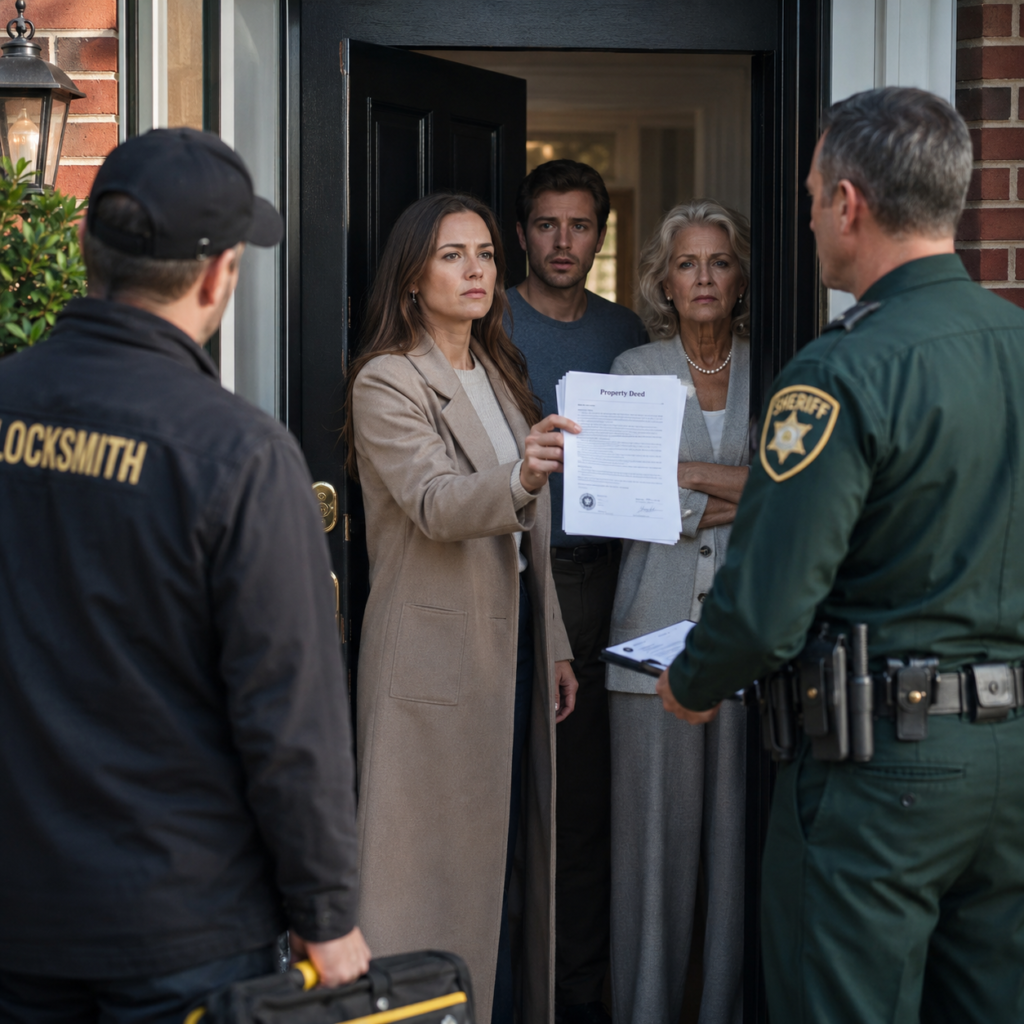
Then I hired a locksmith.
Finally, I visited the county sheriff’s office.
Not because anyone had committed a crime.
Because I wanted to prevent one.
Civil standbys existed for situations exactly like this.
On the sixth morning I drove home.
Behind my car came another vehicle carrying the locksmith.
Behind him came a sheriff’s patrol SUV.
Lucas opened the front door before I reached it.
Relief flooded his face.
“Claire.”
Behind him Beatrice appeared.
“So you’ve finally decided to come home.”
“I have.”
She noticed the uniform.
Her smile faded.
The sheriff introduced himself politely.
“I understand there’s a property access matter.”
Lucas looked confused.
“What is this?”
“My house,” I answered.
“My parents live here.”
“No.”
“They’re family.”
“They’re guests.”
Beatrice stepped forward.
“We’re not leaving.”
The sheriff remained calm.
“Ma’am, whose name appears on the deed?”
“That isn’t relevant.”
“It is.”
She looked toward Lucas.
He said nothing.
I handed the sheriff the certified property records.
He glanced through them.
Then nodded once.
“Mrs. Avery owns the residence.”
Lucas swallowed.
“I live here.”
The sheriff looked at me.
“Would you like your husband to remain?”
The silence stretched.
Lucas stared at me with desperate hope.
I realized he still believed this was about winning an argument.
It wasn’t.
It was about trust.
And that had already been lost.
“You may stay temporarily while we begin legal separation,” I said quietly.
His face went white.
“But your parents cannot.”
Beatrice laughed.
“You can’t remove us.”
The sheriff answered instead.
“Actually, she can.”
Everything changed after that.
Gordon stood first.
Without protest.
He looked tired.
Embarrassed.
Almost relieved.
“I told you this wasn’t a good idea,” he muttered to his wife.
She ignored him.
She argued.
Threatened lawsuits.
Claimed emotional abuse.
Claimed family rights.
Claimed Lucas had invited them.
The sheriff listened patiently.
Then repeated one sentence.
“The homeowner has withdrawn permission.”
An hour later the suitcases were back on the front porch.
The locksmith replaced every exterior lock.
Lucas watched silently.
When the last lock clicked into place, he whispered, “You planned all of this.”
“No.”
I looked at him sadly.
“I prepared.”
“There was no other way?”
“There were dozens.”
“You chose this one.”
“You chose yours first.”
His shoulders collapsed.
“I never thought you’d leave.”
“I know.”
“Mom said you’d eventually accept it.”
“I know.”
“I thought keeping everyone happy was possible.”
I shook my head.
“You weren’t keeping everyone happy.”
I glanced toward the empty driveway where his parents’ car had disappeared.
“You were asking one person to sacrifice everything so everyone else could avoid discomfort.”
He cried then.
Not loudly.
Just quietly enough that I almost reached for him.
Almost.
Instead, I handed him an envelope.
Inside were separation papers.
He looked at them without opening them.
“I love you.”
“I believe you.”
“Then why?”
“Because love without respect becomes permission.”
Weeks later, neighbors quietly asked what had happened.
Rumors spread.
Some blamed me.
Others blamed Beatrice.
I corrected no one.
The truth didn’t need defending.
Three months later, I finished organizing the kitchen again.
Every spice returned to its proper drawer.
Every handwritten label exactly where I had placed it years before.
My gray cardigan hung once again inside my own closet.
One cool autumn morning I stood alone at the island, drinking coffee while sunlight filled the room.
The house was silent.
Peaceful.
Mine.
For the first time in months, it didn’t feel empty.
It felt safe.
Only later did I discover the final surprise.
Among the documents my attorney had requested was a copy of Lucas’s email correspondence.
One message, written weeks before his parents moved in, had never been meant for my eyes.
His mother had written, “Once we’re established, she’ll eventually adjust. If she resists, remind her marriage means compromise. She values peace too much to risk losing you.”
Lucas’s reply was only one sentence.
“I think you’re right.”
I closed the email without anger.
Because both of them had misunderstood the same thing.
They believed peace belonged to whoever demanded the most.
They never imagined that the quiet woman who spent years building her dream home had also spent years building the courage to walk away from anyone who forgot it was hers.