
The revolving doors whispered shut behind them, sealing out the orchestra, the crystal chandeliers, and the applause that had never truly belonged to them.
Snow drifted through the city in quiet sheets as Julian guided Alma toward the curb. She kept apologizing, each sentence softer than the last.
“I’m sorry, sweetheart. I didn’t mean to ruin your evening.”
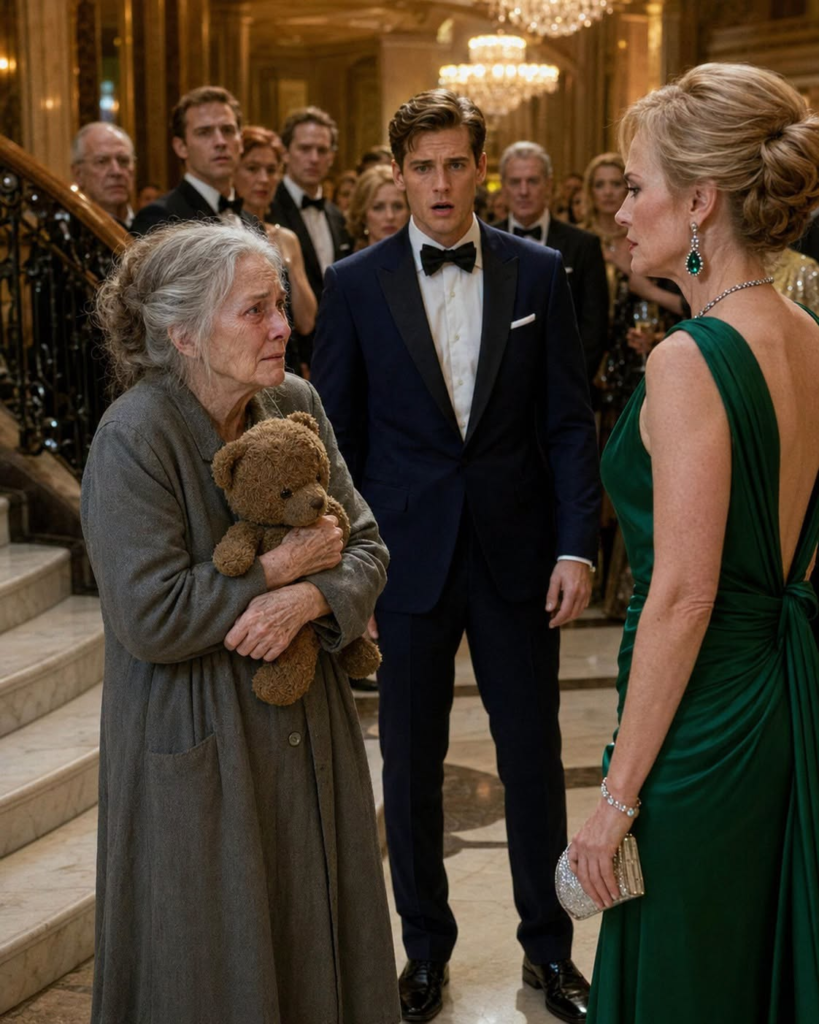
He stopped beside the taxi stand and gently held her shoulders.
“You didn’t ruin anything.”
“But that young woman…”
“She showed me something I needed to see.”
Alma looked away, ashamed.
“I should have worn better clothes.”
Julian smiled sadly.
“If you’d arrived wearing diamonds, she would have treated you like royalty. That’s exactly the problem.”
The taxi driver recognized Julian from the business magazines lying on his dashboard.
“Mr. Whitaker? Aren’t you supposed to be at the charity ball?”
Julian opened the back door for his mother.
“I’m exactly where I’m supposed to be.”
As the taxi disappeared into the snowy streets, the gala behind them continued in awkward silence.
Inside the ballroom, Benedict Hart had just stepped onto the stage. Tall, silver-haired, and commanding every room he entered, he adjusted the microphone with practiced confidence.
“Ladies and gentlemen, tonight we celebrate a remarkable partnership…”
He paused.
Julian’s seat was empty.
Vivian stood frozen near the entrance, unable to move while hundreds of eyes drifted toward her.
One of the hotel staff hurried to Benedict and whispered into his ear.
The billionaire’s expression barely changed.
“Please excuse me for a moment.”
He disappeared backstage.
Vivian followed.
“Dad…”
“What happened?”
“There was… some misunderstanding.”
“I asked what happened.”
Vivian hesitated.
“There was an old woman.”
“And?”
“I thought she was trespassing.”
“And?”
“I asked security to remove her.”
Benedict remained silent.
“It turns out…” she whispered, “…she was Julian’s mother.”
For several seconds he simply stared at his daughter.
Then he asked the one question she feared most.
“Did you ask her who she was?”
“No.”
“Did you ask whether she needed help?”
“No.”
“Did you insult her?”
Vivian’s silence answered for her.
Benedict closed his eyes.
“You’ve just cost us something money cannot replace.”
Meanwhile, Julian brought Alma to the modest apartment she still refused to leave despite his repeated offers to buy her a house.
She made tea while he sat at the tiny kitchen table, still holding the faded teddy bear.
“I was going to wait until next week,” he said.
“Wait for what?”
He opened his leather portfolio.
Inside were architectural drawings unlike anything Alma had ever seen.
Entire neighborhoods.
Schools.
Parks.
Community gardens.
Libraries.
Affordable apartments built around sunlight instead of parking lots.
“What is all this?”
“It’s Haven City.”
She blinked.
“The city council approved the land three months ago.”
“I thought you only designed buildings.”
“I did.”
He smiled.
“Now I’m building communities.”
She turned another page.
The scale was breathtaking.
“This… this would change thousands of lives.”
“Hundreds of thousands.”
He nodded.
“The partnership Benedict wanted tonight would finance phase one.”
Alma looked up.
“And now?”
“I don’t know.”
She reached across the table.
“Maybe you should call Vivian.”
Julian shook his head.
“No.”
“But your dream…”
“My dream isn’t worth losing myself.”
Across town, Vivian couldn’t sleep.
For the first time in years, social media wasn’t celebrating her latest charity gala.
Instead, short videos from the hotel lobby had spread across every platform.
The clips were brief but devastating.
An elegantly dressed woman mocking an elderly stranger.
A trembling voice saying, “I just need to see my son.”
Julian’s quiet words.
“This is my mother.”
Millions watched.
Millions judged.
By morning, newspapers weren’t writing about the gala.
They were asking how the city’s most famous philanthropist could publicly humiliate an elderly woman carrying nothing but an old teddy bear.
Vivian released an apology.
People called it polished.
They also called it empty.
Two days later she went to Julian’s office.
His assistant recognized her immediately.
“Do you have an appointment?”
“No.”
“I’m sorry. Mr. Whitaker isn’t accepting visitors.”
“Please.”
The assistant disappeared.
A minute later she returned.
“He says no.”
Vivian stood there for several seconds before quietly leaving.
She had never been told no before.
Not once.
The following week brought an even bigger surprise.
An international investment group announced it had acquired a controlling interest in HavenLine Designs.
The investors had watched the hotel footage.
They had researched Julian afterward.
What they found impressed them far more than his architecture.
A scholarship student.
The son of a widow.
No scandals.
No hidden accounts.
No political favors.
Just talent and integrity.
Their chairman explained during the press conference,
“We invest in people before we invest in projects. Anyone willing to walk away from immense personal gain to protect his mother understands the value of foundations. Buildings need them. Character does too.”
The funding exceeded everything Benedict Hart had offered.
Construction on Haven City began within six months.
The first families moved in two years later.
The apartments were beautiful, energy-efficient, and affordable.
Every building was wheelchair accessible.
Every courtyard had trees.
Every child could walk safely to school.
On opening day, reporters surrounded Julian.
“What inspired this project?”
He looked toward the front row.
Alma sat there wearing a new blue coat he had secretly bought her.
She still carried the old teddy bear.
“My mother once told me that a home isn’t measured by how expensive it is.”
He smiled.
“It’s measured by whether someone feels safe enough to cry there.”
The quote appeared in newspapers across Europe.
Universities invited him to speak.
Cities sought his advice.
Within five years, HavenLine had become one of the continent’s most respected urban development firms.
Ironically, Benedict Hart’s empire began shrinking.
Luxury projects stalled.
Investors preferred socially responsible developments.
Public opinion had changed.
People wanted builders who understood ordinary lives.
One rainy afternoon, nearly seven years after the gala, Alma asked Julian to stop the car outside a small neighborhood café.
Inside sat a woman reading alone.
Vivian.
She looked different.
Older.
Quieter.
The confidence that had once entered rooms before she did had softened into something almost fragile.
When she looked up and saw them, surprise crossed her face.
She immediately stood.
“I can leave.”
Alma gently touched her arm.
“You don’t have to.”
The three of them sat together.
An awkward silence lingered.
Finally Vivian spoke.
“I’ve rehearsed this conversation for years.”
Julian remained calm.
“I’m listening.”
She looked at Alma.
“I can’t undo what I did.”
“No,” Alma answered softly.
“I’ve tried volunteering without cameras. I’ve worked in shelters. I’ve apologized a thousand times in my head.”
Her eyes filled.
“But I know none of that erases who I was that night.”
Julian studied her carefully.
She seemed sincere.
Not because she cried.
Because she no longer expected forgiveness as payment for her remorse.
“I spent years blaming you,” he admitted.
“Then I realized something.”
“What?”
“You weren’t born cruel.”
She frowned.
“You were taught that appearances reveal value.”
She nodded slowly.
“I was.”
“And you’ve spent years unlearning it.”
“I have.”
Alma reached into her handbag.
She placed the worn teddy bear on the table.
Vivian stared at it.
“I hated that bear.”
“I know,” Alma smiled.
“I almost threw it away many times. Julian refused.”
Julian laughed.
“It made me brave.”
Vivian looked at the faded stitches.
“So this little thing changed everything.”
“No,” Julian said quietly.
“It only revealed what was already there.”
Before leaving, Vivian turned to Alma.
“I don’t deserve this question.”
“But may I hug you?”
Alma opened her arms without hesitation.
Some wounds never disappear.
But some people choose not to pass them forward.
Months later, the city unveiled its newest public square.
There were no statues of politicians.
No bronze businessmen.
At the center stood a simple sculpture.
An elderly woman in a plain coat placing a small teddy bear into a young boy’s hands.
The plaque beneath read:
Every great city is built twice.
First by the hands that sacrifice in silence.
Then by the hearts that finally learn to see them.
Tourists often asked who the woman was.
Guides usually smiled.
“Just a mother.”
Only the people who knew the real story understood that those two words carried more power than any title, fortune, or family name ever could.