
“I made sure the truth had witnesses.”
For the first time since I had met Julian Rooke, I watched certainty disappear from his face.
“What are you talking about?” he demanded, though the confidence in his voice cracked around the edges.
My phone vibrated once more.
Then again.
The secure livestream had reached everyone it was supposed to reach.
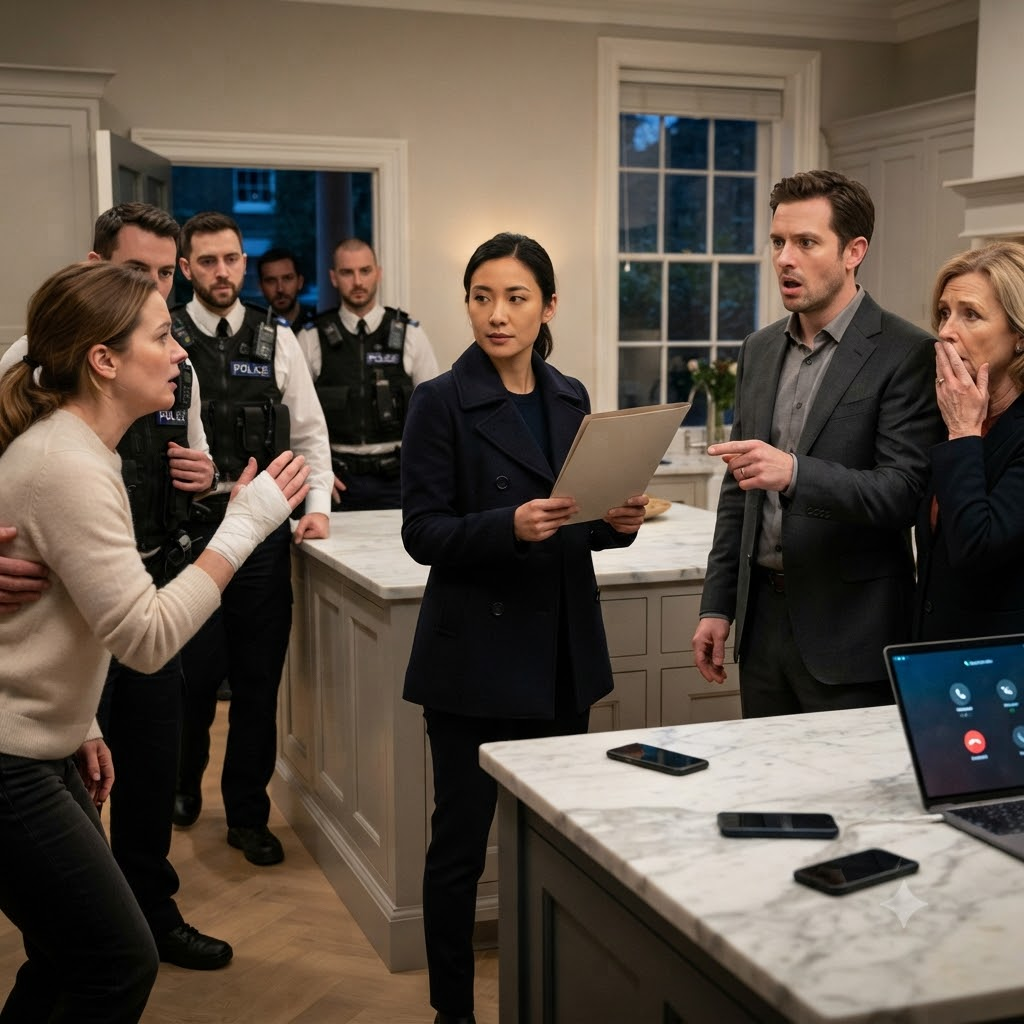
Julian looked toward the kitchen island, then at the tiny recessed panel beneath it. His eyes widened with the sick realization that something inside his perfectly controlled world had slipped beyond his reach.
“You recorded us?”
“I protected myself.”
“You insane little—”
His words stopped as another call interrupted him.
He ignored it.
Then another.
And another.
Margot stared at her own screen, her lipstick suddenly looking too bright against skin that had gone almost gray.
“They’re all calling,” she whispered.
Conrad snatched his phone from the table.
“This has to be some misunderstanding.”
He answered.
“Yes?”
He listened for only a few seconds before the blood drained from his face.
“No… no, you’ve got this wrong.”
His voice grew quieter.
“You can’t suspend the meeting.”
Silence.
Then the line went dead.
Julian lunged toward me.
Instinctively, I stepped backward despite the pain shooting through my hand.
Before he reached me, the front door exploded open.
“Police!”
Three officers entered the townhouse with practiced precision.
Detective Mara Chen walked behind them, calm as ever, her dark coat still damp from the evening rain.
She didn’t look surprised.
She looked exactly like someone arriving on schedule.
Julian froze.
Margot forced a smile.
“There must be some mistake. My son would never—”
“The livestream gave us probable cause,” Mara interrupted. “Along with six years of evidence your daughter-in-law provided.”
Margot’s smile disappeared.
Julian pointed at me.
“She manipulated this.”
“No,” Mara replied evenly. “She documented it.”
An officer approached me carefully.
“Ma’am, we need to get you medical attention.”
I finally allowed myself to breathe.
The adrenaline that had carried me through the last several minutes vanished all at once.
My knees buckled.
The officer caught me before I hit the floor.
As they guided me toward the door, I glanced back.
Julian wasn’t looking at me.
He was staring at Mara.
“You can’t arrest me because of one argument.”
“One argument?” Mara asked.
She held up a thin folder.
“This contains photographs, medical records, financial documents, witness statements, audio recordings, hidden-camera footage, deleted text messages recovered from cloud backups, and evidence of coercive control dating back nearly six years.”
Julian’s expression hardened.
“You’ve been spying on me.”
“I’ve been surviving you.”
Those were the last words I spoke before the ambulance doors closed.
Hours later, after surgery on my hand, I woke beneath the harsh lights of a hospital room.
The doctor explained the burns were severe but treatable. Months of rehabilitation lay ahead.
As he spoke, I barely heard him.
For the first time in six years, I knew Julian couldn’t walk through the door.
That realization felt stranger than freedom itself.
Freedom wasn’t loud.
It was the absence of fear.
The next morning every major financial publication carried the same story.
Rising Harrow Capital executive suspended after domestic abuse evidence surfaces during private family dinner.
The articles spread faster than anyone expected.
The livestream itself never became public.
Mara had made sure of that.
The investigation required preserving the original evidence.
But enough people had seen it.
Enough people knew.
Within forty-eight hours Harrow Capital announced Julian’s immediate termination pending criminal proceedings.
Margot quietly resigned from every charitable board she served on.
Conrad disappeared from public view.
Their empire had not collapsed because of rumors.
It collapsed because people finally saw the truth.
Weeks passed.
Physical therapy hurt almost as much as the burn itself.
My left hand trembled every morning.
Simple tasks became exhausting.
Buttoning a shirt.
Holding a coffee mug.
Typing more than a few sentences.
Some days I cried after therapy sessions, not because of the pain but because I hated depending on anyone.
Mara visited often.
“You know what surprises me?” she said one afternoon.
“What?”
“You never asked if they’ll go to prison.”
I watched rain slide across the hospital window.
“I spent six years thinking prison was the only ending that mattered.”
“And now?”
“Now I just want my life back.”
She smiled.
“That answer tells me you’ve already won.”
The criminal investigation uncovered far more than domestic violence.
Julian had quietly diverted company funds into shell corporations.
Conrad had approved transactions that should never have passed internal audits.
Margot had pressured former employees into signing confidentiality agreements after workplace harassment complaints.
The family’s image had hidden more than cruelty inside the home.
It had hidden corruption everywhere else.
One evening my attorney placed a thick folder in front of me.
“The divorce is straightforward.”
“Straightforward?”
“He signed a prenup assuming you were financially dependent.”
I laughed for the first time in months.
“He never asked what I owned.”
“He assumed he already knew.”
That assumption became his greatest mistake.
The townhouse belonged entirely to me.
The investment accounts in question were mine long before the marriage.
The cybersecurity company I’d sold years earlier had left me independently wealthy.
Julian had spent years trying to control a woman who had never needed his money.
Only her own courage.
The court hearings attracted reporters from across Europe and America.
Julian arrived each morning looking thinner than the day before.
He never looked at me.
His lawyers argued that stress had caused an isolated incident.
Mara calmly played clips from recordings spanning years.
Threats.
Insults.
Admissions.
Apologies that always ended with more violence.
The courtroom remained silent.
Facts have a way of removing emotion from lies.
During a recess Julian finally approached me.
His suit hung loosely now.
Dark circles framed his eyes.
“You ruined everything.”
I studied the man I had once mistaken for strength.
“No.”
My voice remained calm.
“You did.”
He lowered his head.
“You could have talked to me.”
“I tried.”
“You could have left.”
“I tried.”
“You could have forgiven me.”
“I did.”
He frowned.
“Every single time.”
He had no answer.
Months later the verdict arrived.
Multiple convictions.
Years in prison.
Financial penalties.
Professional disqualification.
The Rooke name vanished from magazine covers almost overnight.
The world moved on.
As it always does.
I didn’t.
Not immediately.
Healing isn’t a straight line.
Some nights I still woke believing someone was standing beside my bed.
Sometimes I flinched when a man raised his voice across a crowded café.
Sometimes the scars on my hand burned even though the wounds had long since closed.
Trauma leaves quietly.
It never announces its departure.
Nearly a year later I accepted an invitation to speak at a conference in Copenhagen about digital evidence in domestic abuse cases.
I almost declined.
Public attention had never interested me.
Then Mara said something that changed my mind.
“You don’t owe anyone your story.”
“I know.”
“But someone out there needs to hear it.”
The auditorium was full.
Lawyers.
Police officers.
Judges.
Survivors.
Students.
When I stepped onto the stage, my heart pounded harder than it had inside the courtroom.
I looked at my scarred hand resting against the podium.
For years I had hidden it inside gloves.
Not anymore.
“I used to believe surviving meant staying alive,” I began.
“I was wrong.”
The room became perfectly still.
“Surviving means refusing to let someone else decide who you are.”
After the applause ended, dozens of people waited to speak with me.
One young woman remained until everyone else had gone.
She couldn’t have been older than twenty-five.
She rolled back her sleeve.
A fading bruise covered her wrist.
“I thought nobody would believe me,” she whispered.
I gently turned my scarred palm upward.
“They will,” I said.
“But first, you have to believe yourself.”
She nodded, tears filling her eyes.
As she walked away, I noticed someone standing near the exit.
An elderly man wearing a maintenance uniform.
He smiled politely before leaving.
The conference organizer approached me moments later.
“Do you know him?”
“No.”
“He said he used to work for Harrow Capital.”
I felt my stomach tighten.
“What did he want?”
“He only asked me to tell you something.”
“What?”
She smiled softly.
“He said, ‘Watching that livestream gave the rest of us the courage to tell the truth too.’”
I stood there long after the building had emptied.
For years I believed the hidden cameras had been installed to save my own life.
Standing alone beneath the fading evening light, I finally understood they had done something far greater.
The fire that scarred my hand had illuminated every lie built around it.
Truth had spread farther than fear ever could.
And that was something no one could ever silence again.