
I turned and walked through the heavy oak doors, my footsteps echoing against the marble with a steady, military precision that Cordelia, in her vanity, interpreted as the trembling gait of a woman about to break. As I entered the courtroom, the air shifted. It was an environment I knew better than my own living room. The layout, the scent of floor wax and old paper, the rhythmic thrum of the stenotype machine—it was the arena where I had spent a lifetime exposing truths that powerful men had paid fortunes to conceal.
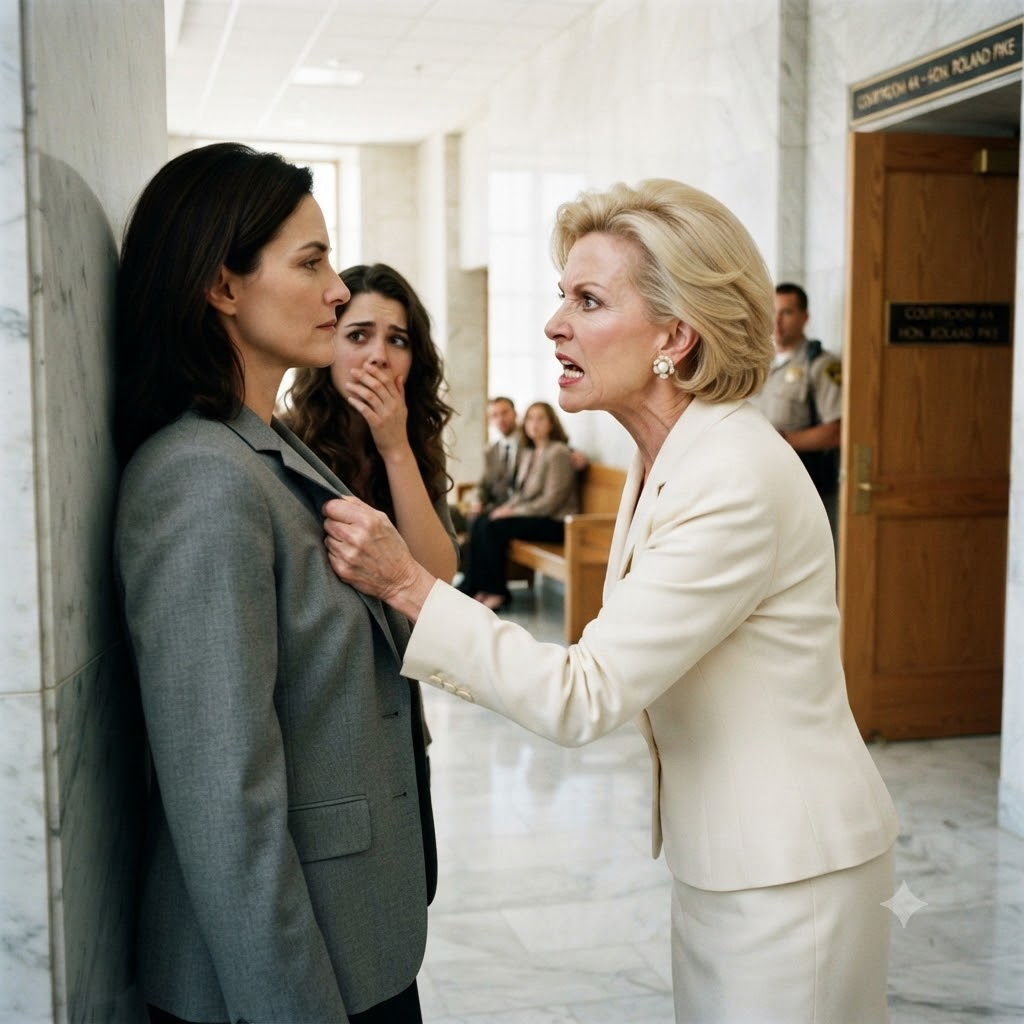
Judge Roland Pike, a man whose reputation for intolerance regarding legal theatrics was legend, sat behind the bench. He peered over his half-moon spectacles as the parties took their seats. Cordelia occupied the plaintiff’s table with the entitlement of a queen returning to her throne. She smoothed her skirt, her face a mask of calculated, grieving elegance. I took my place at the defense table, alone, my single thin portfolio resting on the mahogany surface like a tombstone.
Graham Sutter rose to open. He began with a performance that would have won awards in a lower-tier theater. He painted me as a manipulative interloper who had preyed upon a sickly, vulnerable man, coercing him into bequeathing the Whitcomb sanctuary to someone who didn’t understand its value. He spoke of legacy, of ancestral rights, and of the profound disrespect shown to a grieving mother. His voice was a velvet whip, and he used it well. When he finished, he didn’t just sit; he struck a pose, glancing at the gallery as if waiting for applause.
Judge Pike looked at me. Mrs. Vale, he said, his voice gravelly and impatient. Do you wish to present an opening statement, or shall we move directly to the petitioner’s motion for summary judgment?
I stood. I did not rush. I did not look at Cordelia, though I could feel her eyes burning into the side of my head, expecting me to stammer or weep. I smoothed the jacket of my blazer and stepped toward the lectern. My voice, when it came, was not the soft, trembling tone Cordelia had grown accustomed to over the years. It was the voice that had once commanded silence in rooms filled with generals.
Your Honor, I began, the syllables crisp and carrying to the furthest reaches of the courtroom. The petitioner has spun a narrative of emotional vulnerability. She has characterized me as an unrepresented widow lacking the resources to defend her home. She is half right. I am a widow. But the premise that I am unrepresented is a falsehood that serves as the foundation of this entire litigation.
I opened the thin leather portfolio. It did not contain frantic notes or emotional pleas. It held three meticulously organized documents.
I am not merely a widow, I continued, my gaze locking onto Judge Pike. I am a retired Colonel of the United States Army, Judge Advocate General’s Corps, with twenty-eight years of experience in probate, estate law, and the complex intersection of military and civil asset litigation. I am, in fact, the attorney of record for the defense.
A ripple of confusion—then silence—swept through the room. Cordelia’s face went white. She turned to Graham Sutter, who was already scrambling, his shark-like smile replaced by a look of dawning, frantic comprehension.
I did not stop. I moved to the first document. The petitioner claims that the lake house was improperly transferred due to my supposed undue influence, I said, handing the evidence to the bailiff. This is the notarized video deposition of my late husband, recorded three days before his passing. It is signed not only by his primary physician but by two independent witnesses—a notary and a state-certified chaplain. In it, Daniel clearly articulates his desire that the property be removed from the Whitcomb estate trust and placed into a private trust for our daughter, Lila. He cites the specific history of the property’s neglect by the petitioner’s side of the family and his explicit wish that his wife be the sole guardian of his legacy.
Cordelia let out a sharp, strangled sound, but the Judge gestured for her to remain silent.
I moved to the second document. The petitioner has repeatedly alleged that I isolated my husband during his final months, I continued. This, however, is a log of all communications, visitation requests, and medical interventions during that period. It shows that Daniel personally drafted a request to the hospital’s security department to deny the petitioner access to his room due to the extreme emotional distress she caused him during his periods of intense treatment. It was not isolation, Your Honor. It was a dying man’s choice of peace.
Sutter was on his feet, his composure shattered. Your Honor, this is irrelevant—
The Judge cut him off with a single, sharp look. Sit down, Mr. Sutter. Proceed, Colonel.
I reached for the final document, the one that would ensure Cordelia would never bother my daughter or me again. This, I said, holding up a forensic accounting report, is a summary of the Whitcomb estate’s financial history. For years, the petitioner has been leveraging the lake house as collateral for high-risk private equity ventures. As of last month, those ventures collapsed. The petition to reclaim this house was never about family legacy or grief. It was a desperate attempt to liquidate a property the petitioner no longer legally controls in order to cover debts that are currently under investigation for fraudulent disclosure.
The room felt as though the oxygen had been sucked out of it. Cordelia stood up, shaking, her pearls rattling against her throat. You liar! she shrieked, the veneer of the elegant grieving mother shattering into a million jagged pieces. You stole him! You stole everything!
The bailiff moved toward her, but I didn’t need him to. I looked directly at her—not with anger, but with the chilling, detached clarity of a prosecutor watching a witness collapse on the stand.
Everything you have claimed is a matter of record, I said, my voice quiet but cutting through the courtroom chaos. Your debts, your failed ventures, and your attempt to harass a surviving widow are all documented in the evidence I have provided the court. I didn’t steal your son, Cordelia. I simply gave him the dignity you were too greedy to provide. And today, I am ensuring that the only thing you will inherit from this case is the bill for your own legal fees and a court-ordered injunction that will prevent you from ever coming within five hundred feet of my home or my daughter again.
The silence that followed was absolute. It was the silence of a truth that could not be argued with, only endured.
Judge Pike looked down at the documents, then at the trembling woman at the plaintiff’s table, and finally at me. He didn’t smile—judges don’t do that—but there was a glimmer of something like respect in his eyes. He understood. He had seen the games the wealthy played, and he had just seen the end of a game that should never have begun.
The case was dismissed with prejudice within twenty minutes.
As I walked out of the courtroom, the heavy doors swung shut behind me, sealing away the noise of the trial and the bitter ghost of the woman who had thought she could bully me. Lila was waiting in the hallway. Her face was pale, her eyes wide with shock, but as she looked at me—really looked at me—she straightened. She didn’t see the woman who baked pies or stayed quiet at holiday dinners. She saw the mother she had only ever heard about in stories, the woman who had fought the world and won.
We walked out of the courthouse and into the bright, sharp sunlight of the afternoon. The city hummed around us, indifferent to the small, cold war that had just ended on its third floor. I didn’t look back to see if Cordelia had emerged. It didn’t matter. The house at Blue Heron Lake was safe, and for the first time in a year, the weight of the grief that had been forced upon me by others began to lift, replaced by the quiet, steady strength of the life I had built on my own terms.
As we reached the car, Lila took my hand. Mom, she whispered, I had no idea.
I squeezed her fingers, feeling the cool breeze off the lake, imagining the green of the shutters and the way the light would hit the water when we returned. I didn’t tell her that being a prosecutor wasn’t about being invincible. I didn’t tell her that underneath the blazer, my own heart had been racing just as fast as hers.
I just smiled, the secret of my life locked away once more, and held the door open. We had a home to get back to, and for the first time, it was finally, truly ours.