
I stared at him, the scent of the white roses in my hand suddenly cloying and suffocating. Rowan’s presence in the doorway was a physical barrier, his casual posture masking a predatory edge that made the hair on my arms stand up. Behind him, the room was shrouded in shadow, the heavy velvet curtains drawn tight against the morning sun.
“She hasn’t eaten, Rowan,” I said, my voice steady despite the adrenaline surging through me. “And Lionel is expecting her. If she’s ill, I should call the doctor, not leave flowers.”
Rowan chuckled, a sound devoid of mirth. “Vivienne is fine. She’s just… exhausted. Being a new bride is hard work, isn’t it?” He reached out, his fingers brushing against mine as he took the bouquet. He didn’t even look at the flowers; his gaze was fixed on my face, searching for a sign of surrender. “Go downstairs, Nora. Don’t make me tell you again.”
He closed the door, the click of the lock sounding like a gavel.
I stood there for a long time, the air in the hallway feeling thin. I didn’t go downstairs. Instead, I retreated to the guest bathroom at the end of the hall, splashing cold water on my face, trying to rationalize the irrational. Maybe she really was just tired. Maybe the humiliation of the situation had driven her to hide. But the memory of that slight thud kept playing over in my mind, a rhythmic, disturbing echo.
That night, the house felt like a tomb. Adrian was away on business, a trip he hadn’t mentioned until the last minute, and the children were at my sister’s house for a sleepover. It was just me, the sleeping staff, and the silent, imposing presence of the third floor.
At midnight, unable to quiet the storm in my head, I crept upstairs. My intention was just to leave a note, to force some form of communication. When I reached the door, I didn’t knock. I held my breath and leaned in, my heart hammering against my ribs.
That was when I heard it. The whimpering.
“Please, don’t send it,” she whispered, her voice fractured, stripped of the iron-willed authority that had intimidated three generations. “I did everything you wanted. Please, Rowan. Don’t ruin me.”
My blood ran cold. The silence that followed was heavy, and then I heard a low, raspy laugh—not Rowan’s, but something deeper, more calculated.
“You should have thought about that before you signed, Vivienne,” a voice hissed—a voice that wasn’t Rowan’s. It was a man, cold and precise. “The money is gone. The house is leveraged. You’re a prisoner in your own legacy now. One wrong move, one whisper of the truth to your precious son, and those photos go to the press. Everyone will know exactly how you saved the estate after Malcolm died. They’ll know you’re not a widow; they’ll know you’re a thief.”
I pressed my hand against my mouth to suppress a gasp. The realization hit me with the force of a physical blow: Rowan wasn’t a lover. He was an extortionist, a puppet in a much larger, darker game. And he wasn’t working alone.
I backed away, my bare feet silent on the hardwood, but my mind was screaming. Every piece of the puzzle rearranged itself in the dark. The “grief” that had made Vivienne so cold—it wasn’t just loss. She had embezzled funds from the estate years ago to keep the family in luxury after Malcolm’s sudden death, and someone had found out. She had been living in terror, and when she couldn’t pay, they sent Rowan to take what remained of the house and the reputation she had spent her life shielding.
I reached my bedroom and locked the door, my hands trembling as I grabbed my laptop. I didn’t call the police; I didn’t know if they were already in on it, or if the scandal would destroy us before the truth could be told. I began to dig. I searched through old accounts, hidden emails, and financial records I had access to as the manager of the household.
It took hours, but at 4:00 AM, I found it. A hidden offshore account in the Cayman Islands, linked to a shell corporation that had been funnelling money into the Whitlock accounts for months—funds that were now being bled dry by Rowan and his associates.
The sun began to bleed over the horizon, turning the gray stone of the house into a pale, ghostly white. I didn’t feel fear anymore. I felt a cold, sharp clarity. Vivienne had been a monster to me for years, but she was a victim of a parasite, and that parasite was currently sleeping in her bed.
I didn’t wait for Adrian. I didn’t wait for permission. I walked to the third floor, my head held high, and didn’t knock. I pushed the door open.
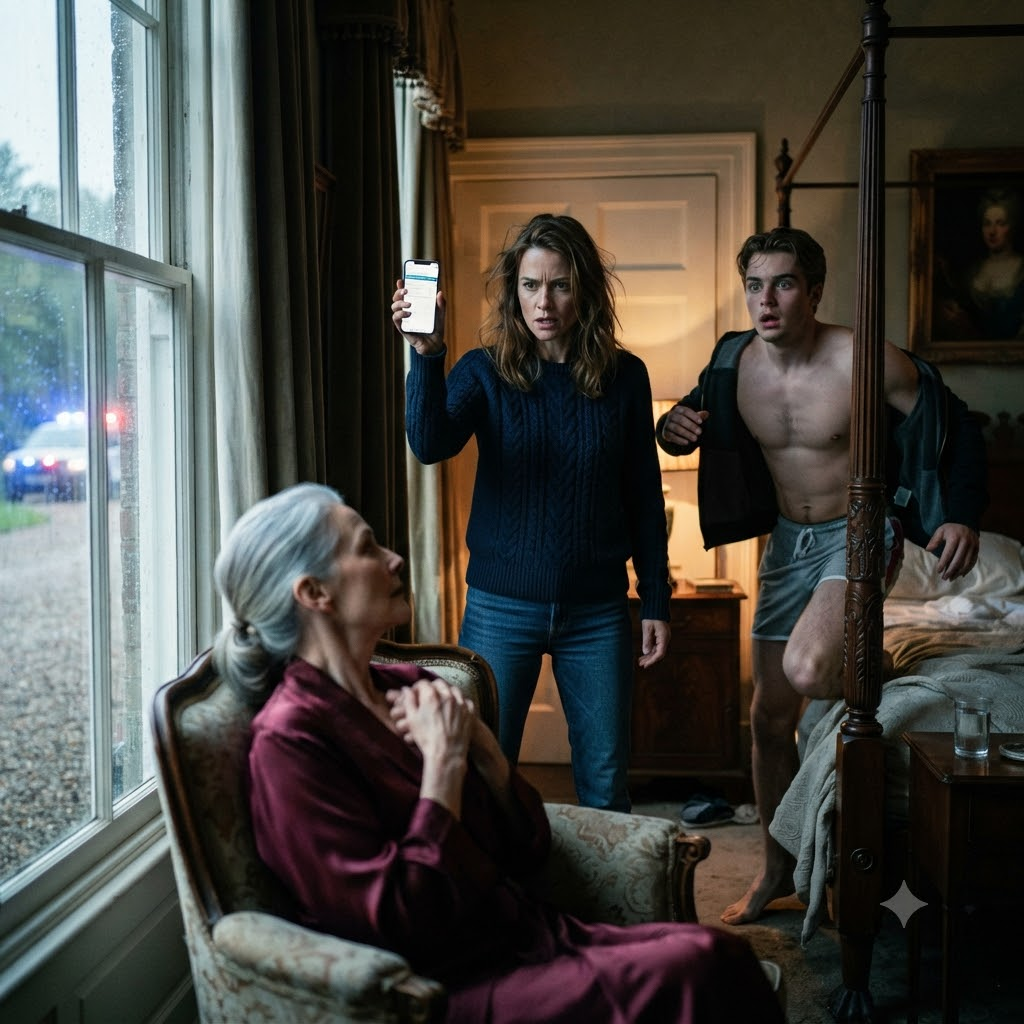
Rowan was asleep, his clothes strewn across the floor. Vivienne was sitting in the armchair by the window, a silk robe pulled tight around her thin frame. Her eyes were bloodshot, her face a map of absolute despair. When she saw me, her breath hitched, and she looked at the door, terrified.
“Nora,” she breathed, her voice trembling. “Get out.”
“I know about the offshore account, Vivienne,” I said, my voice steady, echoing in the room.
Rowan stirred, blinking awake, his eyes narrowing as he sat up. “What the hell are you doing here?”
“I have the records,” I said, stepping closer, holding up my phone. “I’ve already forwarded them to the authorities, along with the proof of your extortion. The police are already on their way, Rowan. And I’ve also emailed the full history of the family estate’s finances to the local prosecutor. You’re not getting the house, and you’re not getting another cent.”
Rowan lunged out of bed, his face twisted into a mask of pure rage. “You think anyone will believe you? You’re just the bitter daughter-in-law! I have photos of her that will destroy this family!”
“I don’t care,” I said, and for the first time, I meant it. “Let them see it. Let them know she stole to keep the house. Let them know she was a failure. At least it will be the truth. And it will be over.”
Vivienne began to sob, a sound that finally broke the last of the ice in my heart. She wasn’t an iron queen anymore; she was just a woman who had tried to build a cage to protect herself and had ended up locked inside it.
Rowan stood frozen for a second, his eyes darting to the door, then back to me. He realized the game had changed. The leverage he held over Vivienne was the fear of public ruin, but I had just burned the house down with us in it. He couldn’t blackmail us if we had already confessed.
Sirens began to wail in the distance, a low, rising sound that cut through the morning stillness of Bellhaven.
Rowan cursed, grabbed his jacket, and bolted for the door, pushing past me. He didn’t even look back. He was a coward, and cowards always run when the light is turned on.
I walked over to Vivienne, who was curled into herself, shivering. I didn’t offer comfort, and I didn’t offer forgiveness. I didn’t need to. I pulled the heavy curtains back, and for the first time in a decade, the morning light flooded the room, harsh and unforgiving.
“The police are coming,” I said, looking out at the gravel driveway where flashing lights were beginning to cut through the trees. “You’ll lose the house. You’ll lose your standing in this town. You might even go to prison for the fraud.”
Vivienne looked up at me, her eyes hollow, the mask of the elegant widow completely shattered. “Why?” she whispered. “Why save me?”
I looked at her, seeing the wrinkles, the fear, the humanity she had hidden so deeply. “Because,” I said, “I wanted to see what was behind the door. And because justice is a much better legacy than a lie.”
As the officers stormed the house, I turned to walk away. The scandal of the Whitlock family was just beginning, and for the first time, I was the one holding the pen. The shame was no longer a secret to be kept behind a locked door; it was a weight that had finally been lifted, leaving us with nothing but the truth, and in that, I finally found my freedom.