
I locked the heavy door, threw the latch, and lowered Lucia onto the living room sofa. The fabric of my couch instantly absorbed her sweat and the damp night air of Quezon City. Her chest heaved violently, each raspy breath sounding like torn paper. The broken medical boot dangled off her left foot, its plastic shell cracked down the seam.
“Take it easy, Lucia,” I whispered, kneeling beside her. My heart beat loudly against my ribs. “I’ve got you. You’re safe here.”
She clutched my wrist with a grip so fierce and desperate that her fingernails bit into my flesh. “They took them, Kak Mari,” she gasped, her voice barely a thread. “They… they were going to put me away tomorrow. A private facility in Cavite. No visitors. No phones.”
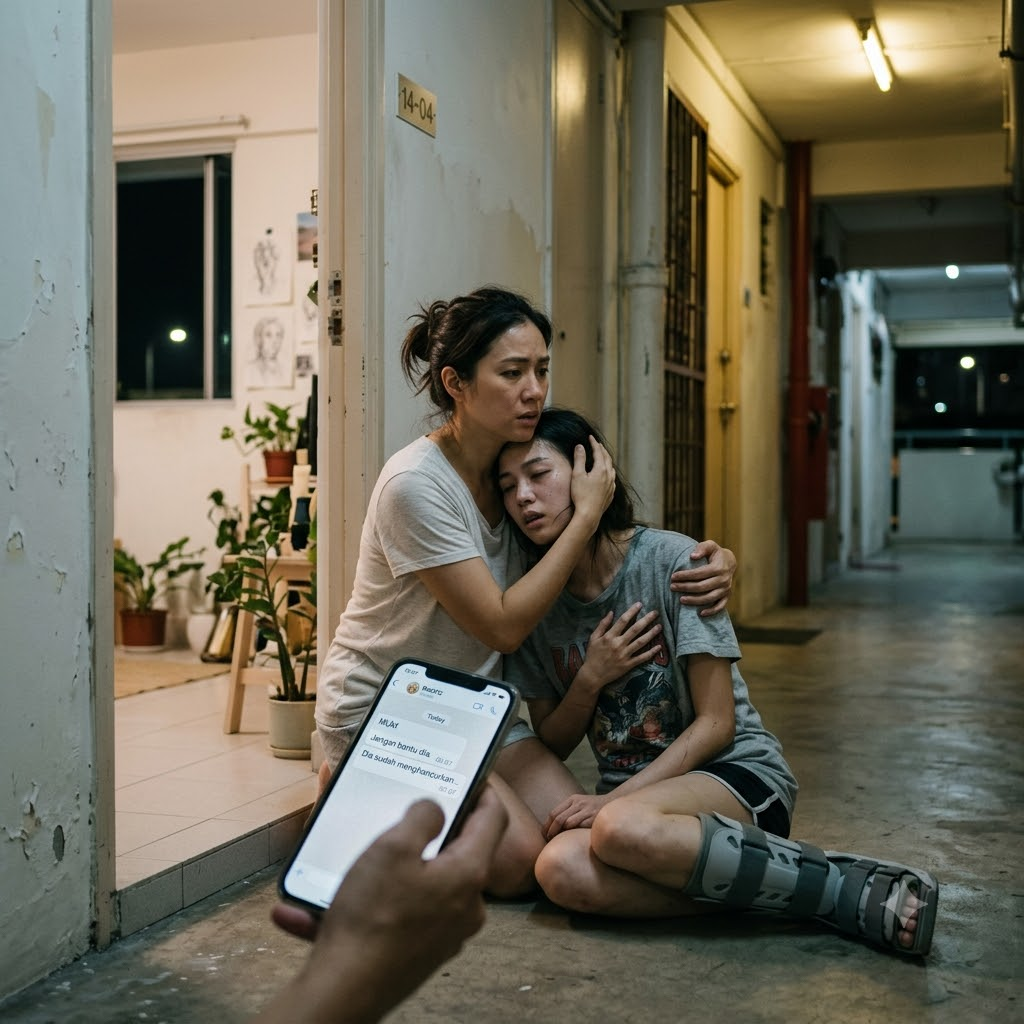
My phone buzzed again in my pocket. I pulled it out.
Beatriz (Mum): She took her documents. She took the money from the safe. Send her back right now, Mariana, or I will call the police on both of you.
I stared at the screen, my hands trembling. The cold, mechanical tone of my mother’s words sent a shudder down my spine. For years, I had believed her narrative—that Lucia was manipulative, that her pain was exaggerated, that Mum and Dad were just long-suffering parents dealing with a troubled daughter. But looking at Lucia now—her collarbones protruding like sharp ledges, her body shuddering in agony—the scales fell from my eyes with sickening clarity.
“What documents, Lucia?” I asked softly, smoothing back her matted hair.
Lucia fumbled inside the oversized denim jacket she was wearing. With trembling fingers, she pulled out a thick yellow envelope, bent at the corners and stained with water. She shoved it into my hands.
“Look at the dates,” she breathed, closing her eyes as another spasm of pain swept through her lower back. “Look at the medical records.”
I unbuttoned the envelope and pulled out a stack of papers. The topmost pages were recent hospital bills and diagnostic reports from top orthopedic centers in Manila—documents Mum had always claimed never existed. But as I flipped further back, past the recent records, I found the original files from the night of the accident nine years ago.
Attached to a detailed surgical report was a official document I had never seen before: a legal settlement from the insurance company of the transport firm whose jeepney had crashed into Lucia’s car.
My breath caught in my throat.
The settlement was for twelve million pesos.
It was a structured payout, meant specifically for Lucia’s long-term medical care, lifelong specialized therapy, and pain management. It had been deposited into a trust account set up under my father’s name as her legal custodian while she was a minor.
My eyes scanned down to the bank statements attached behind it. The monthly disbursements were massive. But the money had never gone to Lucia’s medical bills.
Every single month for the past nine years, the funds were systematically transferred out. Some went to paying off heavy debts; others went directly into funding my university tuition, my design equipment, my rent allowance when I first moved to Metro Manila, and even the lavish renovations on our family home in Lipa.
I sat back on the floor, paralyzed by shock. My entire life—my clean start, my independence, my pride in being the successful, self-sufficient daughter—had been bought and paid for with my sister’s suffering.
Mum and Dad hadn’t kept Lucia isolated because she was dramatic or lazy. They had kept her sick, dependent, and hidden away so she would never discover the trust fund, never ask for her money, and never realize that her parents had squandered her lifelong medical care to build a facade of respectability and fund my bright future. They denied her specialists because actual medical treatment would require using the money that was already gone.
“Mari…” Lucia’s weak voice broke through my spiraling thoughts. “Do you see it now? I wasn’t making it up. The doctor said back then… I could have walked normally again. I could have had surgery. But Dad signed a refusal form… he said we couldn’t afford it…”
Tears welled in my eyes, burning with intense shame and guilt. “Oh god, Lucia… I’m so sorry. I’m so, so sorry…”
“It’s not your fault,” she whispered, her eyes shining with tears under the dim yellow ambient lighting of my apartment. “You didn’t know.”
Suddenly, the silence of the night was shattered by three loud, deliberate knocks on my front door.
Knock. Knock. Knock.
Lucia stiffened, her eyes widening in sheer terror. She tried to push herself up, but her back gave out, and she sank back into the cushions with a choked cry of pain.
“Mariana.”
My father’s voice rang out from the corridor, cool, calm, and utterly devoid of affection.
“Open the door, Mariana,” he said through the thick wood. “Your mother and I know she’s in there. Bring her out. She’s sick, and she needs to come home.”
I stood up slowly. My hands were still shaking, but the guilt that had weighed me down for years suddenly crystallized into something hard and unyielding. I stepped toward the door, holding the yellow envelope tight against my chest.
“Go away, Dad,” I said, my voice surprisingly steady. “She’s staying with me.”
“Don’t be foolish, Mariana,” my mother’s voice joined in, sharp and impatient. “She steals, she lies, and now she’s filled your head with nonsense. She took things from my safe that don’t belong to her. Open this door right now before we get the building security involved.”
“You mean these insurance papers?” I called back, my voice rising. “The ones showing the twelve million pesos meant for Lucia’s surgeries? The money you spent on our house? The money you used to pay for my life here?”
Silence fell in the corridor. For a long moment, the only sound was the distant hum of traffic from the highway outside.
When my father spoke again, his tone was no longer calm. It was dripping with quiet malice. “Mariana, you have a good job. A good reputation. Think very carefully about what you are doing. If you make a scene, if you drag this family’s name through the dirt, you lose everything too. Who do you think people will believe? A successful lawyer and a former nurse… or a disgraced graphic designer harboring an unstable runaway?”
“I don’t care,” I said quietly.
“Mariana—”
“I am opening this door now,” I said, my hand touching the cold metal lock. “And I have already recorded this conversation on my phone. If you don’t walk away from my door in five seconds, I will upload the audio and every single page of these bank statements straight to the police and your law firm’s managing partners.”
It was a bluff—I hadn’t started recording until that very moment—but the silence on the other side of the door was absolute. I could hear my mother’s sharp intake of breath.
Slowly, footsteps retreated down the hallway, echoing off the concrete walls until they faded entirely.
I leaned my forehead against the cool surface of the door, trembling as the adrenaline slowly drained from my body. They were gone for now, though I knew the legal war ahead would be long and brutal. But for the first time in nine years, the air in the room felt clear.
I turned back to Lucia. She was looking at me, her eyes filled with a mixture of disbelief and quiet hope.
I walked over, sat beside her on the sofa, and took her cold, trembling hand in mine.
“Tomorrow,” I said gently, “we find you a real doctor. A real specialist. And then we get a lawyer.”
Lucia gave a small, fragile smile—the first true smile I had seen on her face since she was nineteen years old. She squeezed my hand back, her grip stronger this time.
Outside, the darkness of the early morning began to soften as the first grey light of dawn touched the city skyline. The storm was far from over, but as I sat beside my sister in the quiet apartment, I knew one thing for certain: we were finally going to bring the truth to light.