
Gabriel stood by the rain-dark window for several long seconds before answering.
“What happens now,” he said quietly, “is that they discover they chose the wrong family.”
There was no anger in his voice.
That frightened me more than if he had shouted.
For the next forty-eight hours, our home became something between a refuge and a command center. Detectives came and went. Victim advocates sat beside Vivienne for hours, reminding her that she controlled every statement she gave. A forensic photographer documented every bruise, every cut, every fingerprint-shaped mark left on her body.
Gabriel barely slept.
He had not changed as much as I once believed. His hair carried strands of silver now, and there were lines around his eyes that hadn’t existed during our marriage. But once he accepted responsibility for something, he pursued it with absolute focus.
Except this time, it wasn’t a corporation or a government investigation.
It was our daughter.
By the afternoon, the first surprises began.
The honeymoon suite where Vivienne had been assaulted had supposedly suffered an unexplained security system failure between 10:14 p.m. and 2:03 a.m.
Conveniently, those were the exact hours she claimed Mason and Judith had imprisoned her.
The resort manager insisted there was no usable surveillance footage.
Gabriel simply nodded.
“That’s interesting,” he said.
“Why?” one detective asked.
“Because systems don’t fail,” Gabriel replied. “People make them fail.”
Three hours later, one of his security analysts discovered that although the hallway cameras had gone offline, the hotel’s elevator diagnostics continued recording every stop, every door opening, every weight sensor activation.
At 11:48 p.m., the elevator had carried three people to the honeymoon floor.
At 2:37 a.m., it recorded only one passenger leaving.
The weight matched Vivienne almost exactly.
She had escaped alone.
Mason had lied.
It was the first crack.
The second appeared two days later.
Judith Harrow held a press conference before charges were even filed.
Standing outside her expensive home in a cream-colored suit, she looked directly into the cameras with practiced sorrow.
“My son adored his wife,” she declared. “Vivienne suffered an emotional episode after the wedding. We are deeply concerned about her mental health.”
She even cried.
Not convincingly.
But enough for television.
Within hours, social media exploded.
Some believed Vivienne.
Others questioned why a bride would run away in the middle of the night.
Old photographs surfaced.
Anonymous accounts claimed she’d struggled with anxiety.
Someone leaked private wedding pictures.
I watched my daughter stop looking at her phone altogether.
“I should have signed,” she whispered one evening.
I nearly dropped the mug I was holding.
“What?”
“They would’ve taken the condo.”
“So?”
“At least none of this would’ve happened.”
Gabriel looked up from the dining table.
“No.”
His voice cut through the room.
“You listen to me.”
Vivienne slowly raised her eyes.
“What happened began the moment they believed they owned you.”
She started crying.
“I keep thinking maybe I said something wrong… maybe I made him angry…”
“No.”
“He kept saying I embarrassed him.”
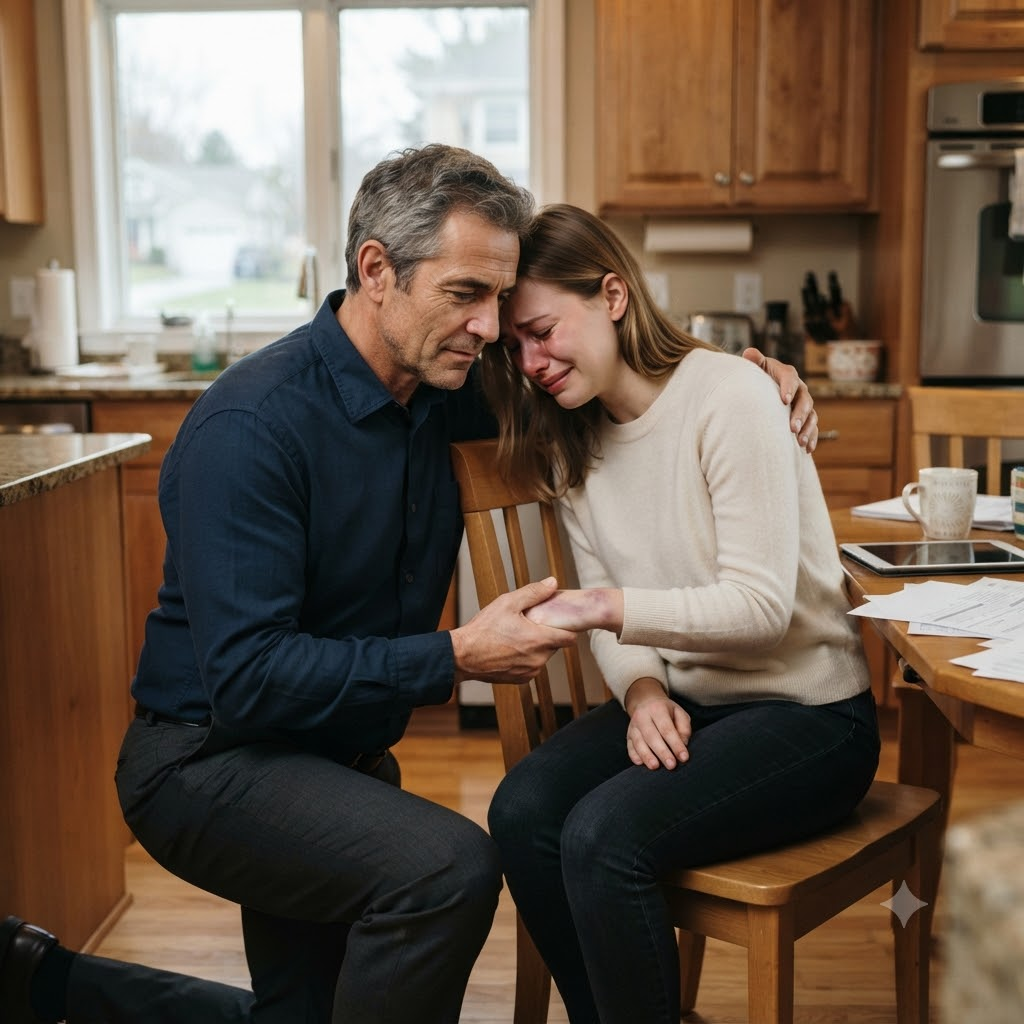
Gabriel walked over and knelt beside her chair.
“Abusers always write a story where they are the victim.”
He gently took her bruised hand.
“You did not create his violence.”
“He loved me.”
“No.”
Gabriel’s answer came without hesitation.
“He loved what he could take from you.”
Silence filled the kitchen.
For the first time since arriving home, Vivienne leaned forward and rested her forehead against her father’s shoulder.
He held her exactly the way he had when she was five years old after falling off her bicycle.
Some things survived divorce.
Some things survived time.
A father’s love was apparently one of them.
The breakthrough came from somewhere no one expected.
A young housekeeper named Elena requested to speak with investigators.
She was terrified.
Judith had warned the staff that anyone discussing the Harrow family would lose their job.
But Elena couldn’t forget what she’d heard that night.
While cleaning a nearby suite shortly after midnight, she’d heard a woman laughing.
Not ordinary laughter.
Counting.
“One.”
A slap.
“Two.”
Another slap.
“Three.”
More laughter.
She’d frozen outside the door.
Then she heard a young woman begging.
Please…
Please stop…
Elena had almost called security.
Instead, she’d convinced herself it was a private argument.
Now she couldn’t sleep.
“I should have helped her,” she sobbed.
The detective shook his head gently.
“You’re helping her now.”
That testimony changed everything.
The arrest warrants were signed the following morning.
Police arrived at Mason’s condominium just after sunrise.
He wasn’t there.
Neither was Judith.
They had disappeared.
News helicopters followed every development.
Commentators debated whether they had fled the country.
Gabriel didn’t seem surprised.
“They expected this.”
“So what now?” I asked.
He smiled faintly.
“They’re running toward the only place they think is safe.”
Three days later, authorities located them in Belgium.
Not hiding.
Negotiating.
Mason had attempted to sell confidential financial information belonging to one of his former employers in exchange for cash.
Unfortunately for him, the buyer had already been cooperating with European investigators in an unrelated fraud case.
He’d walked directly into another investigation.
When Belgian police detained him, they discovered encrypted phones, forged identity documents, and several million euros hidden through shell companies.
Domestic violence was suddenly the least complicated crime attached to his name.
Judith was arrested beside him.
Watching the news, Vivienne didn’t smile.
She only closed her eyes.
“It’s over?”
Gabriel looked at the television.
“No.”
“What do you mean?”
“Court is where truth becomes permanent.”
The trial began eight months later.
By then, many of Vivienne’s bruises had faded.
The invisible ones had not.
She attended therapy twice a week.
She had nightmares.
Loud knocks on doors made her panic.
She refused to wear white.
But she walked into the courthouse on her own.
Mason stared confidently across the room.
He still believed he could manipulate everyone.
His attorney argued that Vivienne had fabricated the assault to escape an unhappy marriage.
Then Gabriel testified.
Not as an advocate.
Not as a father seeking revenge.
As a factual witness.
Hour after hour, he reconstructed the timeline using phone metadata, elevator diagnostics, digital backups, banking records, deleted text messages, and hotel maintenance logs.
Every lie Mason had told collapsed beneath documented evidence.
Then came the final surprise.
Gabriel requested permission to introduce one additional exhibit.
The courtroom grew quiet.
Months earlier, while examining cloud backups recovered from Mason’s phone, investigators had restored an automatically uploaded voice memo.
Neither Mason nor Judith realized the recording application had activated after Mason accidentally pressed a shortcut while shoving his phone into his jacket.
The file lasted twenty-six minutes.
The judge allowed it.
No one in the courtroom moved.
Judith’s voice filled the speakers.
“Forty should be enough.”
Mason laughed.
“She’ll sign before fifty.”
Then came Vivienne’s crying.
The begging.
The sound of another slap.
Someone in the gallery gasped.
A juror wiped away tears.
Mason’s face turned completely white.
His attorney slowly removed his glasses.
The trial ended two days later.
Convictions followed on multiple charges including kidnapping, assault, coercion, conspiracy, and financial fraud.
Sentencing was severe.
Outside the courthouse, reporters surrounded Vivienne.
Microphones stretched toward her.
Cameras flashed.
One journalist asked the question everyone wanted answered.
“What would you say to Mason today?”
Vivienne thought for a long moment.
“When someone hurts you,” she said, “they try to convince you your pain belongs in darkness.”
She looked directly into the cameras.
“They were wrong.”
She turned away without another word.
Life did not magically repair itself afterward.
Healing never does.
There were difficult mornings.
Unexpected tears.
Entire weeks when grief returned without warning.
But there were victories too.
Vivienne sold the waterfront condo—not because anyone forced her to, but because she chose to.
“I don’t want my future living inside a building they tried to steal,” she told us.
Instead, she founded a recovery center for survivors of domestic abuse.
Not a shelter.
A place that combined legal assistance, financial planning, trauma therapy, and career counseling.
Everything she had needed.
Everything she wished had existed years earlier.
The center opened exactly two years after the wedding that never truly became a marriage.
On opening day, hundreds attended.
So did Elena.
The young housekeeper cried when Vivienne hugged her.
“You saved me,” Elena whispered.
“No,” Vivienne answered.
“You found your courage.”
Late that evening, after everyone had left, Gabriel and I stood outside watching our daughter lock the front doors of the center bearing her name.
The sunset painted the old stone buildings in gold.
For the first time in years, silence between us felt peaceful.
“I used to think I failed her,” Gabriel admitted.
“You didn’t.”
“I wasn’t there.”
“You are now.”
He smiled sadly.
“I spent my career teaching people that evidence defeats lies.”
“And?”
“I forgot that love defeats shame.”
Across the street, Vivienne looked up and waved at us.
She looked nothing like the broken young woman who had knocked on my door at 3:07 that terrible morning.
She looked stronger.
Not because she had forgotten.
Because she had survived.
As we walked toward her together, I finally understood something that evil people never seem to learn.
Violence can break bones.
Fear can steal sleep.
Lies can poison reputations.
But when a victim is believed, protected, and loved without condition, the very things meant to destroy them become the foundation of the life they build afterward.
And in the end, that was the one thing Mason and Judith had never imagined.
They thought they had broken our little girl.
Instead, they revealed the extraordinary woman she was always destined to become.