
The afternoon air hit my face with the cool clarity of rain that had not yet fallen.
For the first time all day, I could breathe.
Behind me, the chaos continued. Raised voices drifted across the gardens, mixing with the distant notes of the string quartet that, incredibly, had resumed playing after someone awkwardly requested they continue. It sounded almost surreal, as though two completely different realities had collided in the same place.
Nora caught up beside me, slipping off her heels and carrying both pairs in one hand.
“You okay?” she asked softly.
I laughed.
It surprised both of us.
“I think I’m in shock.”
She slipped an arm around my shoulders.
“No,” she said. “I think you’re finally free.”
Those words settled somewhere deep inside me.
Free.
I had spent months believing I was protecting a relationship by avoiding conflict. Every compromise had seemed small on its own.
Ignore another passive-aggressive comment.
Smile through another uncomfortable dinner.
Pretend another conversation about the condos wasn’t really about control.
Each concession felt harmless.
Until I suddenly found myself standing at an altar where my future had become a business negotiation.
A black sedan rolled toward the entrance.
My father stepped out before the driver could open his door.
He looked at me for a long moment.
“I was worried I’d find you crying.”
“I already did enough crying before today.”
He smiled sadly.
“Your grandfather would have been proud.”
That nearly broke me.
Not because of the inheritance.
Because my grandfather had always measured wealth differently.
When I was twelve, he had taken me to one of the apartment buildings after a hurricane had damaged several units.
Instead of arguing about insurance money, he spent the entire weekend helping elderly tenants replace ruined furniture.
“Buildings aren’t the investment,” he had told me while carrying a refrigerator up two flights of stairs.
“People are.”
I finally cried then.
Not over Graham.
Over the memory of a man who had spent his life teaching me that ownership meant responsibility, never entitlement.
My father hugged me without saying another word.
Sometimes silence was the greatest kindness.
…
By evening, the internet had done what the internet always does.
Someone had recorded almost everything.
The first announcement.
The text messages.
The cancellation.
My walk down the aisle.
By midnight, the video had spread across every major social media platform.
Millions of people watched a bride cancel her own wedding.
News outlets called it “The Wedding Walkout.”
Comment sections exploded.
Half the internet applauded.
The other half insisted family disagreements should stay private.
The only opinion that mattered to me came from an eighty-three-year-old tenant named Mrs. Evelyn Brooks.
She called the next morning.
“I’m sorry about your wedding, sweetheart.”
“I’m sorry you had to see that.”
“Oh, don’t worry about me.”
She chuckled.
“I just wanted to thank you.”
“For what?”
“For protecting what your grandfather built.”
My throat tightened.
“He always said these apartments would stay affordable as long as someone with a good heart owned them.”
She paused.
“I was hoping he’d chosen the right person.”
Another silence.
“I guess he did.”
When we hung up, I sat alone in my kitchen for almost an hour.
That phone call meant more than every supportive comment online combined.
…
Three days later, Graham appeared outside my townhouse.
He looked exhausted.
His expensive suits had disappeared.
Instead, he wore jeans and a wrinkled sweater that made him look younger.
Almost like the man I’d met four years earlier.
“I just want to talk.”
I considered closing the door.
Instead, I stepped onto the porch.
Five minutes.
No more.
“I didn’t know she’d do it like that,” he said immediately.
“I believe you.”
He blinked.
“You do?”
“I don’t think you expected a microphone.”
His shoulders relaxed.
Then I continued.
“But you expected the demand.”
His face fell.
He didn’t deny it.
Instead, he stared at the wooden porch beneath his shoes.
“I thought…if we got married first…everything would calm down.”
“No.”
“It would’ve.”
“No, Graham.”
I shook my head.
“It would’ve become legal.”
He looked up.
“I loved you.”
“I know.”
“I still do.”
“I know.”
He swallowed hard.
“But?”
“But love isn’t the same thing as courage.”
He closed his eyes.
“My mother has always been difficult.”
“I wasn’t marrying your mother.”
“No.”
“You were choosing her.”
The words landed exactly where they needed to.
He didn’t argue.
Didn’t defend himself.
Didn’t blame anyone.
For the first time since I’d met him, he looked honestly at his own reflection.
“I’m sorry.”
“I know.”
“I don’t expect forgiveness.”
“I know.”
He laughed bitterly.
“You keep saying that.”
“Because it’s true.”
I looked at him with genuine sadness.
“I don’t hate you.”
“I almost wish you did.”
“I don’t.”
I smiled faintly.
“I just don’t trust you anymore.”
There wasn’t anything left to say.
He nodded once.
Walked to his car.
Then stopped.
“You know what hurts most?”
“What?”
“I spent four years trying to become the man you deserved.”
He looked over his shoulder.
“And one afternoon proved I never actually was.”
He drove away.
I never saw him again.
…
The legal letters started arriving two weeks later.
Not from Graham.
From Cordelia.
She accused me of defamation.
Emotional damages.
Intentional humiliation.
Business interference.
The list continued for fourteen pages.
I smiled before forwarding everything directly to Iris.
My attorney called twenty minutes later.
“I assume you haven’t responded?”
“Not yet.”
“Excellent.”
“What now?”
“Now…”
I could practically hear her smiling.
“…we send her the recordings she forgot existed.”
Cordelia had chosen a public confrontation.
Bellmere House maintained security cameras across the property.
Audio included.
Her own words.
Her own threats.
Her own demands.
Her own timeline.
Within forty-eight hours, every claim disappeared.
No lawsuit was ever filed.
…
Life became strangely quiet afterward.
I returned to work.
Visited the properties more often.
Spent weekends talking with tenants instead of wedding planners.
Some recognized me from the viral video.
Most pretended they hadn’t.
I appreciated that.
One rainy afternoon in October, I visited Building Seven.
The roof had finally been repaired.
Children played football in the courtyard while grandparents watched from folding chairs.
A little boy kicked the ball too hard.
It rolled to my feet.
I stopped it.
He ran over.
“Thanks, Miss Elena!”
“No problem.”
He grinned.
“My mom says you’re the boss.”
I laughed.
“I’m more like the caretaker.”
He thought about that seriously.
“That’s better.”
Then he grabbed the ball and sprinted away.
Children had a remarkable talent for saying profound things without realizing it.
Caretaker.
Not owner.
Exactly.
…
December arrived with its usual mixture of cold mornings and holiday lights.
One evening, Iris invited me to dinner.
Halfway through dessert, she slid a folder across the table.
“I think you’ll want to read this.”
Inside was a handwritten letter.
The paper was yellowed with age.
The signature belonged to my grandfather.
“I’ve never seen this.”
“He instructed me to give it to you only if you ever questioned whether protecting the trust had been worth the cost.”
My hands trembled as I unfolded it.
Elena,
If you’re reading this, someone has probably tried to convince you that love requires surrender.
It doesn’t.
Real love never asks you to become smaller so someone else can feel bigger.
Money reveals character faster than almost anything.
Some people will think they love you until your boundaries inconvenience them.
When that happens, don’t confuse disappointment with failure.
Losing the wrong people creates room for the right ones.
Protect the buildings.
Protect yourself.
They’re the same promise.
Love,
Grandpa
By the time I finished reading, tears blurred every word.
I understood why he’d waited.
Some lessons only made sense after they became personal.
…
Spring returned almost exactly one year after the wedding that never happened.
Bellmere House hosted another ceremony.
Different couple.
Different flowers.
Different future.
The venue manager had invited me back, apologizing repeatedly for everything that had happened.
I almost declined.
Then I realized I didn’t want one painful memory to own such a beautiful place.
I attended as a guest.
Near sunset, while standing beside the lake, someone approached.
Martin Waverly.
He looked older.
Much older.
“I wasn’t sure you’d speak to me.”
“I’ll listen.”
He nodded gratefully.
“I filed for divorce.”
I looked at him quietly.
“Forty-one years,” he said.
“I should’ve left decades ago.”
The sadness in his voice carried the weight of an entire lifetime.
“I watched her become someone who believed everything belonged to her.”
He stared across the water.
“I kept telling myself keeping the peace was the same thing as doing the right thing.”
He smiled sadly.
“It wasn’t.”
“No.”
“It never is.”
He reached into his jacket pocket.
“I wanted you to have this.”
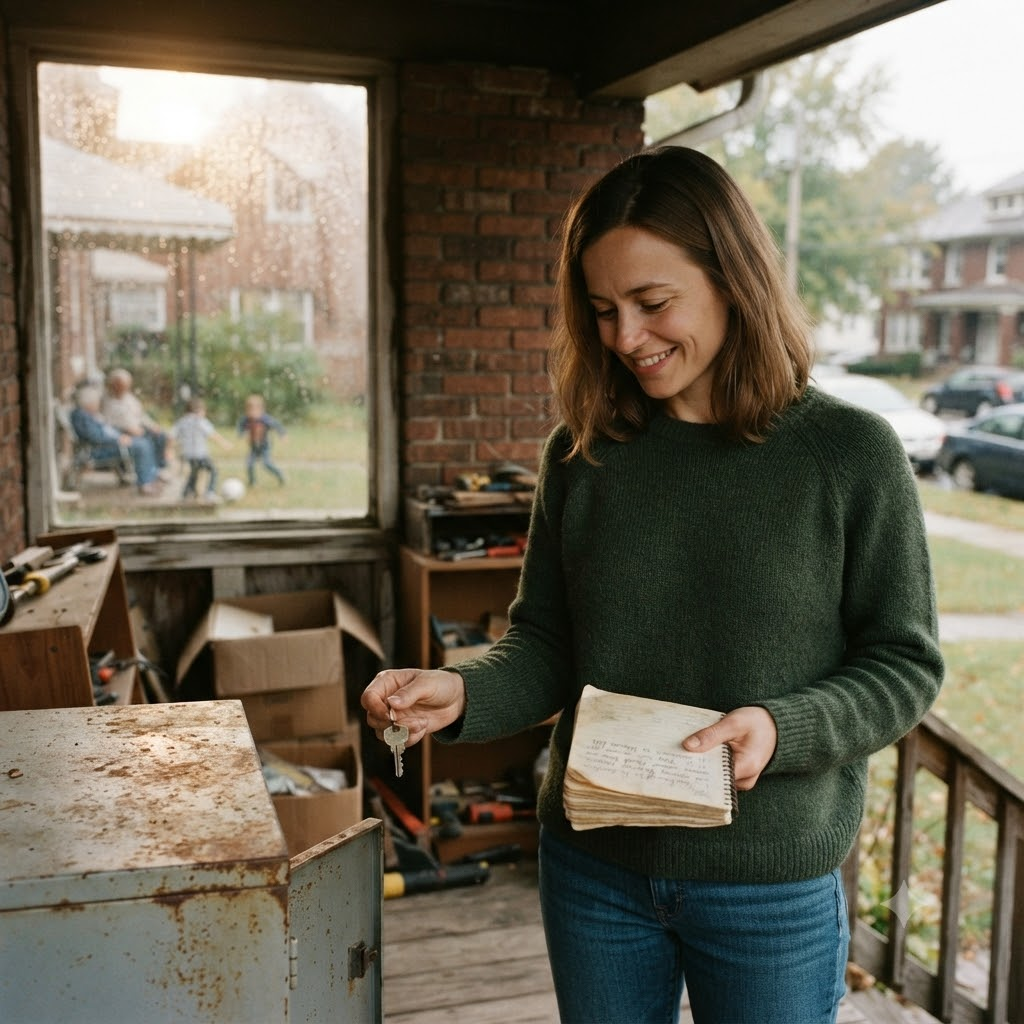
It was a small silver key.
I frowned.
“What is it?”
“The old maintenance office at your grandfather’s first building.”
I looked up in confusion.
“I bought the property from him thirty-five years ago.”
“You knew my grandfather?”
“We were friends before either of us had money.”
He smiled for the first time.
“He left something there years ago.”
…
The next morning, curiosity carried me to the tiny brick building.
The maintenance office had long since been converted into storage.
Inside, dust covered forgotten shelves and rusted tools.
Using the key, I opened an old steel cabinet.
One cardboard box sat inside.
My name was written across the top.
Inside were photographs.
Construction plans.
Tenant Christmas cards.
Children’s drawings.
Letters from families thanking my grandfather for refusing to raise rent after difficult years.
At the very bottom lay a faded notebook.
The first page contained only one sentence.
The measure of success is not how much you keep.
It is how many people remain standing because you refused to let them fall.
I closed the notebook and smiled.
The wedding had ended exactly where it needed to.
Not because I had lost a husband.
Because I had discovered an inheritance far greater than ten condominium buildings.
My grandfather hadn’t left me property.
He had left me principles.
Cordelia believed wealth meant ownership.
Graham believed love could survive without courage.
My grandfather knew something neither of them ever understood.
The most valuable thing you will ever protect is the part of yourself that refuses to be purchased.
And once you refuse to sell that, no one can ever take it away.