
Camille stared at the tiny embroidered label as though it had suddenly become a venomous snake.
“No,” she murmured. “The archive collection has never been available to the public.”
No one moved.
Even the seamstress standing quietly in the corner had stopped pinning a hem.
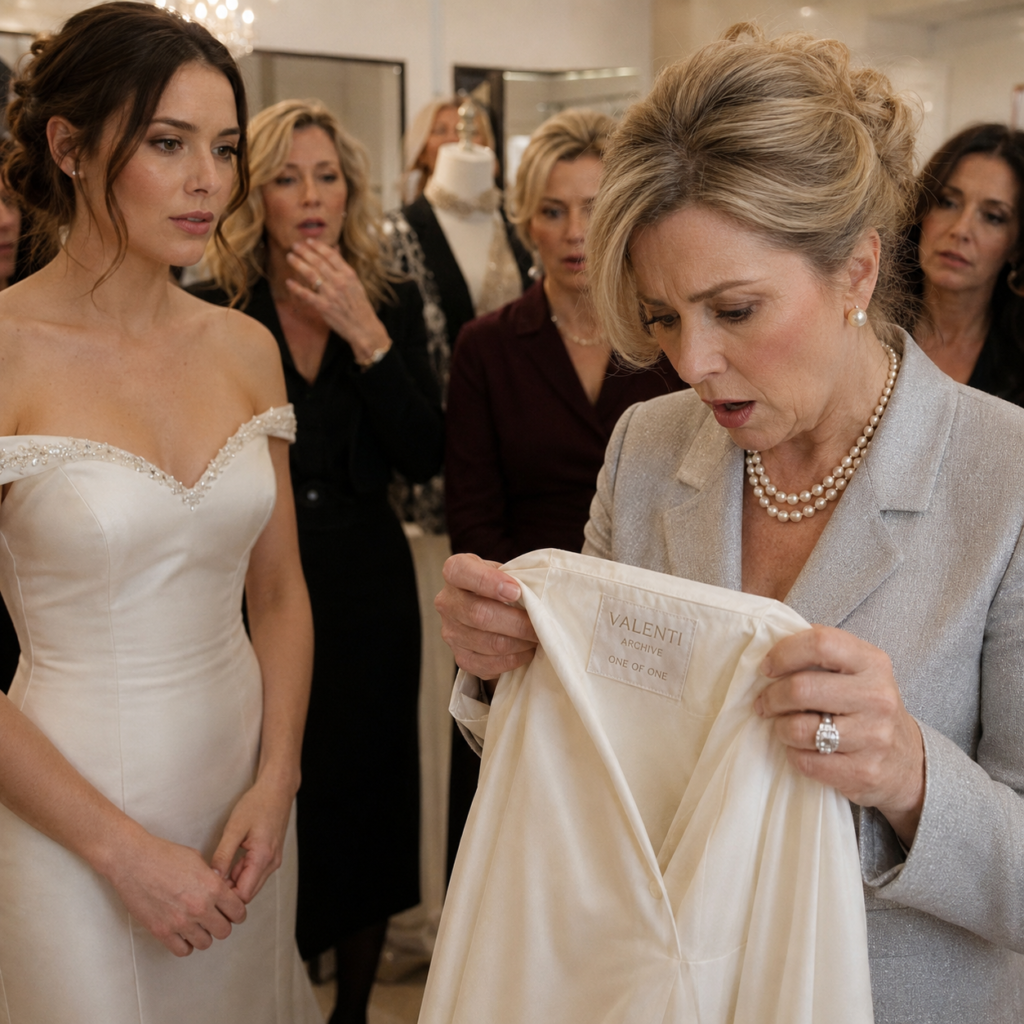
I looked toward my mother. She remained exactly where she had been moments earlier, her hands folded loosely in front of her. There was no satisfaction on her face, no trace of triumph. Only a quiet sadness that seemed older than I had ever noticed.
Maribel finally broke the silence.
“Surely it’s a replica.”
Camille didn’t answer.
Instead, she carefully turned the collar again, exposing another detail hidden beneath the lining. A small hand-stitched signature.
Not printed.
Not embroidered by machine.
Signed by hand.
She looked as though someone had taken the air from her lungs.
“I’ve seen this signature before,” she whispered.
My mother stepped forward.
“Yes,” she said softly. “You have.”
Camille looked up so quickly that her pearl earrings caught the light.
“You…”
My mother smiled politely.
“It has been a very long time.”
For several seconds, Camille simply stared.
Then recognition slowly spread across her face, followed immediately by disbelief.
“Maren…”
The room seemed to shrink around them.
“You know each other?” Genevra asked.
Neither woman answered immediately.
Instead, my mother looked at me.
“I think,” she said gently, “it’s time you heard the whole story.”
I frowned.
“What story?”
She took a slow breath.
“When you were little, I always told you that your grandmother could sew.”
I nodded.
“She taught me.”
“That wasn’t entirely true.”
Camille closed her eyes for a brief moment, as though she already knew what was coming.
My mother continued.
“Your grandmother, Elena Bennett, wasn’t simply a seamstress.”
The room remained perfectly still.
“She founded House Valenti.”
Every face froze.
Maribel laughed instinctively.
“That’s impossible.”
“It isn’t,” Camille replied quietly.
Everyone turned toward her.
She looked almost pale.
“I met Elena Valenti thirty-two years ago.”
I stared at my mother.
“Valenti?”
She nodded.
“Valenti was her maiden name.”
My mind struggled to catch up.
“But… our surname…”
“She changed it after marrying your grandfather.”
Nothing made sense anymore.
“My grandmother created House Valenti?”
“Yes.”
“Then why did nobody ever tell me?”
My mother’s smile carried more regret than happiness.
“Because she never wanted that life to define us.”
The fitting room disappeared around me as memories rushed back.
Grandmother teaching me how to thread a needle.
The old wooden sewing table in her attic.
Her saying that beautiful things should never make people feel smaller.
At the time I thought they were simply lessons about kindness.
Now every word carried a different weight.
My mother sat down slowly.
“When your grandmother was young, she built the fashion house from nothing. Every design came from her hands. Every stitch mattered. The wealthy fought for invitations. Royal families waited years for appointments.”
Camille quietly lowered her gaze.
“She was extraordinary.”
My mother nodded.
“She was. But success changed the people around her.”
She paused.
“Friends became competitors. Family members argued over money. Investors wanted control. Journalists followed her everywhere.”
“What happened?” I whispered.
“One evening,” my mother said, “she came home after a charity gala and looked at me. I was sixteen.”
Her voice softened.
“She asked me one question.”
She closed her eyes, remembering.
“‘Do you know how many people asked whether I was happy tonight?'”
Silence.
“The answer was none.”
My mother’s fingers tightened around one another.
“They asked about sales. About celebrities. About invitations. About wealth. Nobody asked whether she was lonely.”
I felt tears gathering.
“So she left?”
“Eventually.”
She nodded.
“She sold her shares, signed confidentiality agreements, disappeared from public life and raised me somewhere no one knew our name.”
Camille finally spoke.
“The fashion world spent years searching for her.”
“I know.”
“They believed she’d died.”
My mother smiled sadly.
“She preferred that rumor to the truth.”
Maribel looked completely bewildered.
“But… why keep it from your own daughter?”
My mother reached for my hand.
“Because your grandmother feared something.”
“What?”
“That one day you might meet people who valued the label inside your clothes more than the heart inside your chest.”
No one spoke.
The truth hung over the room with impossible weight.
“I wanted you,” my mother continued, “to know who you were before you ever knew who your family had been.”
I couldn’t stop crying now.
“So this dress…”
“She made it.”
I blinked.
“What?”
“Years before she died.”
My mother carefully touched the sleeve.
“She told me she’d designed one final wedding dress. Not for a princess. Not for a celebrity.”
Her voice trembled.
“For her granddaughter.”
I looked down at the silk covering my hands.
Grandmother had passed away five years earlier.
She had already known.
She had imagined this day long before Lucas ever entered my life.
My mother smiled through tears.
“She left me one instruction.”
“What was it?”
“Only give it to Cora when she finds someone who loves her without asking what her family can offer.”
The room became impossibly quiet.
Camille slowly sank into a chair.
For the first time since I’d met her, she looked neither elegant nor intimidating.
She looked ashamed.
“I judged you,” she admitted.
“You did.”
“I judged your parents.”
“You did.”
“I assumed…”
She couldn’t finish.
“You assumed kindness belonged to ordinary people and greatness belonged to wealthy ones,” my mother answered gently.
Camille covered her face.
“I did.”
No one mocked her.
No one celebrated.
Some victories are too painful to enjoy.
Two weeks later the wedding arrived.
The Waverly estate looked exactly as Camille had always imagined.
Fresh white roses lined the garden.
A string quartet played beneath ancient oak trees.
Guests arrived wearing tailored suits and designer gowns.
People whispered as I walked toward the ceremony.
Some recognized the dress.
Most didn’t.
That no longer mattered.
Lucas stood waiting beneath the floral arch.
The moment he saw me, tears immediately filled his eyes.
“You look…”
He laughed helplessly.
“I don’t even have words.”
“You don’t need them.”
He squeezed my hands.
“I’d marry you if you came wearing jeans.”
I smiled.
“I know.”
That was why I was there.
Not because of the dress.
Because of the man waiting for me.
The ceremony was simple.
Honest.
Everything I’d hoped marriage would be.
At the reception, Camille approached me while guests danced beneath hanging lights.
She held a small velvet box.
“I owe you something.”
“You don’t owe me anything.”
“I do.”
She opened the box.
Inside rested an antique silver thimble.
Very old.
Beautifully engraved.
“This belonged to Elena.”
I stared.
“How do you have this?”
“She gave it to me.”
I looked up, confused.
Camille took a deep breath.
“When I was twenty-four, I wanted to become a designer.”
That surprised everyone standing nearby.
“I met your grandmother during an internship.”
She smiled faintly.
“I was talented.”
“I believe you.”
“But I was ambitious for the wrong reasons.”
She looked toward the guests.
“I wanted famous clients. Magazine covers. Prestige.”
She swallowed.
“One afternoon she watched me criticize another apprentice’s work.”
I could almost imagine my grandmother’s expression.
“What did she say?”
Camille laughed softly.
“She handed me this thimble.”
She looked at it lovingly.
“Then she said, ‘The day you begin measuring people by labels instead of character is the day your talent becomes worthless.'”
My chest tightened.
“I ignored her.”
She nodded.
“I left. Married into money. Spent decades believing status was proof of success.”
She closed the box.
“I forgot everything she tried to teach me.”
She placed it gently into my hands.
“I think it belongs back with her family.”
I held the tiny silver thimble as though it were made of glass.
“Thank you.”
Camille looked at me with eyes that no longer carried superiority.
Only humility.
“I spent months trying to decide whether you were worthy of becoming a Waverly.”
She smiled sadly.
“I never realized the question should have been whether we were worthy of joining your family.”
Months passed.
Life slowly settled into ordinary happiness.
Lucas and I bought a modest house instead of the mansion everyone expected.
My classroom remained exactly where it had always been.
Children still cared far more about storybooks than designer clothing.
One rainy Saturday, my mother invited me over.
She carried a weathered wooden chest from the attic.
“I think you’re ready.”
Inside lay hundreds of sketches.
Fabric samples.
Letters.
Photographs.
The entire private history of Elena Valenti.
At the very bottom rested one sealed envelope addressed in graceful handwriting.
For My Great-Grandchildren.
I opened it carefully.
Inside was only one handwritten sentence.
“If our family name ever becomes more important than the way we treat strangers, let the name disappear again.”
I read it twice.
Then a third time.
Only then did I finally understand why my grandmother had hidden from the world.
She hadn’t abandoned her legacy.
She had protected it.
Because silk fades.
Fashion changes.
Fortunes rise and fall.
Even legendary names eventually become footnotes in history.
But the quiet dignity of treating another human being with kindness when no one is watching…
That is the only inheritance that never goes out of style.