
“She said it was your farewell note,” Hannah murmured, her voice trembling so violently she had to grip the edge of a metal shelf to stay upright. “She told me you’d had time to think in that hospital bed, that you realized you were being groomed to take over your father’s firm, and that a girl from a dead-end town like mine would only be a liability to your future. She told me the money wasn’t a bribe; she called it a ‘graceful exit fee.’ She said if I loved you at all, I would disappear before you woke up, so you wouldn’t have to face the humiliation of dumping me yourself.”
The grocery store lights seemed to flicker, or maybe it was just my vision tunneling. The sterile, fluorescent hum of the aisle felt like a crushing weight. Everything I had built my life upon—my resentment, my career, the cold distance I had kept from my mother—was built on a foundation of rot.
“I didn’t write that letter, Hannah,” I whispered, the words tasting like ash. “I spent five years hating you for words I never spoke.”
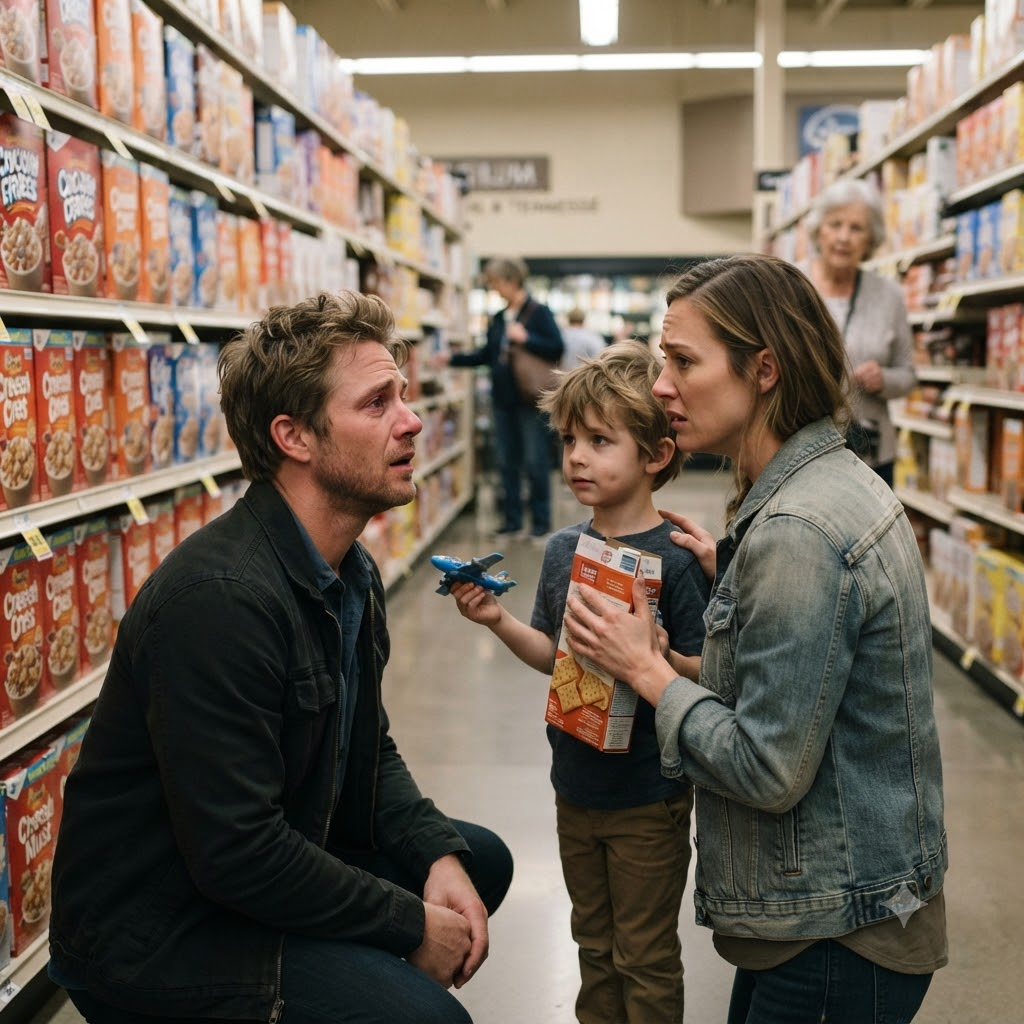
“And I spent five years raising a child in the shadows, waiting for a knock on the door that never came,” she countered, her voice rising with a sharp, jagged edge of grief. “I moved here because it was halfway across the country. I worked three jobs. I looked at Lucas every single morning and saw your face, and I had to tell him his father was a man who simply chose a life without us.”
I moved toward her, desperate to touch her hand, to prove she was real, but she flinched away, creating an invisible barrier that felt more substantial than steel.
“Where is the letter?” I demanded. “Where is the check?”
“Burned,” she said. “I burned them the day I finished paying for his first year of daycare. I didn’t want the reminder of what I was worth to your mother.”
Lucas appeared at the end of the aisle, clutching a box of crackers, his brow furrowed. “Mom? Are we going now?”
Seeing him, the realization hit me with the force of a tidal wave. This wasn’t just about my mother’s betrayal; it was about a stolen childhood. I hadn’t just lost five years of love; I had lost five years of fatherhood. I had been cheated out of his first steps, his first words, the way he learned to hold a crayon. My mother hadn’t just manipulated a breakup; she had orchestrated an abduction of my own life.
“Lucas,” I said, my voice cracking. I knelt, trying to make myself small, trying to be less terrifying. “Can I… can I see that airplane?”
He looked to Hannah for permission. She stood frozen, a statue of grief, but she gave a nearly imperceptible nod. He walked over, his small, warm hand extending the toy toward me. As our fingers brushed, a jolt of electric recognition surged through me. He was mine. There was no denying the biology, the soul, the sudden, fierce instinct to shield him from everything—even his own grandmother.
“I need to talk to you, Hannah,” I said, standing up. “Not here. Not now. But you cannot leave again. If you try to disappear, I will find you. I have resources, and I have five years of lost time to make up for.”
“You don’t get to command me, Jake,” she snapped, though her resolve was crumbling. She looked at Lucas, then back at me, her eyes searching for the man she had loved, the one who wasn’t a pawn of his family’s legacy. “You don’t know what it’s like to be hunted by your mother. She isn’t just a controlling parent; she’s a woman who thinks she can buy destinies.”
“I know,” I said, reaching for my wallet and pulling out a business card. I didn’t want her to rely on me, but I needed her to know I was reachable. “I didn’t know then. I know now.”
She took the card, her fingers lingering against mine for a fleeting second—a ghost of the intimacy we once shared. She didn’t say yes, but she didn’t run. She walked to the checkout, Lucas trotting beside her. I followed at a distance, watching them leave the store and head toward a beat-up sedan in the parking lot.
As I sat in my rental car, watching them pull away, I didn’t call the police. I didn’t call my father. I dialed the only person who might understand the depth of my mother’s reach: a private investigator I had hired years ago to look into the accident, whom I had fired when the letter arrived.
“I have a name,” I said when he answered. “And I have a target. I want you to find out exactly how much my mother paid for the silence she bought.”
I spent the next three days in a haze of fury and strategy. I stayed in a small motel, mapping out my next move. I wasn’t just going to confront my mother; I was going to dismantle the gilded cage she lived in. But the real surprise came on the fourth day.
Hannah didn’t call, but she showed up at my motel door. She looked even more exhausted, holding a thick, manila envelope. She walked past me into the room, setting the envelope on the cheap wooden desk.
“You wanted the truth?” she asked. “The letter wasn’t just a goodbye, Jake. It was a condition.”
I opened the envelope. Inside were copies of medical reports from five years ago, legal documents I had never seen, and a bank statement showing a massive, recurring deposit that had started the week after my accident.
“Your mother didn’t just pay me to leave,” Hannah said, her voice hollow. “She paid me to stay silent about why you were in that car. She told me that if I ever told you the truth about the accident—about who was actually driving—you would go to prison for the rest of your life. She said the price of your freedom was my exile.”
My heart stopped. The accident. I remembered the rain, the screech of tires, the smell of burnt rubber, but I had blocked out the driver’s side. I had always assumed I was behind the wheel. I looked at the papers, at the police report from the county precinct, listing a driver who was not me.
My mother had been driving. She had been intoxicated. She had dragged me into the driver’s seat after the crash, knowing I had a concussion and would likely have no memory of the switch. She hadn’t just framed Hannah for leaving; she had used my own trauma to make me believe I was the one who needed saving.
I looked at Hannah, the woman I had blamed for a betrayal that was actually a sacrifice. She had been protecting me from the truth of my own mother’s cold-bloodedness.
“She told you that if you stayed, she’d ensure I went to jail?” I asked, my voice barely audible.
“She said she would destroy both of us,” Hannah whispered. “She was a monster, Jake. She still is.”
I looked at the window, at the setting sun casting long, dark shadows across the room. I had been living a life of anger, believing I was the victim of a woman’s greed, only to realize I was the beneficiary of a mother’s sociopathy.
I turned to Hannah, reaching out to take her hand, no longer a stranger, but a partner in a tragedy we had both been forced to play parts in. We were no longer victims of her design. We had the evidence, we had the truth, and for the first time in five years, the narrative was finally, violently, ours.
“She thinks we’re still afraid,” I said, grabbing my keys. “Let’s show her exactly how much we’ve grown.”
As we walked out into the cool Tennessee air, I didn’t look back at the room. I looked at Lucas, waiting by the car, and for the first time, I saw not just my face, but our future—a clean slate, written in the only ink that mattered: the truth.