
The flower sat on the mahogany desk, a cheap, synthetic mockery of the garden I had nurtured for thirty years. Its stem was bent, its color a chemical magenta that didn’t exist in nature, and as the morning sun hit it, the plastic shimmered with a tackiness that felt like a slap. I didn’t throw it away. Instead, I placed it next to the thick stack of legal documents I had been organizing since the small hours of the morning.
My phone, which usually remained quiet unless a client from London needed an emergency audit, began to light up at 7:00 AM. It started with a text from Sloane: “Mom, saw the email from the firm’s board. What is this about ‘preliminary dissolution notice’? You didn’t say anything about selling the company.”
I didn’t reply. I poured a cup of coffee, the steam rising in the quiet air of a house that finally felt like mine again, and waited.
By 9:00 AM, the calls started. My daughter’s name flashed on the screen with a frequency that suggested panic, not concern. She called, hung up, and called again. I left the phone on the counter and watched the digital clock change. Thirty-one times. Each vibration was a reminder of the life I had built for her, a life she had mistakenly assumed was a birthright rather than a loan.
When I finally slid the “accept” button, her voice was a thin, high-pitched wire of controlled hysteria. “Mother, are you insane? You’re selling? Now? Preston just landed the contract for the West End development! He needs the firm’s infrastructure to bridge the initial costs. If you pull the funding now, the bank will call in the loan on our house. Do you have any idea what you’re doing?”
“I am retiring, Sloane,” I said, my voice sounding older and steadier than I felt. “I am tired of the work.”
“You can’t just stop! The firm is the backbone of… of everything! Who is going to cover the deficit for the kids’ private school? What about our bridge loan?”
“I suppose,” I said, looking at the plastic flower, “you will have to find other sources. Perhaps Celeste has some advice on elegance that can be traded for cash.”
There was a silence on the other end, heavy and hollow. The realization was beginning to dawn on her—the realization that the safety net she had been walking on for decades hadn’t been made of magic, but of my labor.
“Is this about the ring?” she whispered, her voice dropping to a dangerous, defensive tremor. “Are you really this petty? Over a piece of jewelry? You’re threatening to dismantle my entire existence because I chose to honor my mother-in-law? That is so incredibly selfish, Mom.”
“It isn’t about the ring, Sloane,” I said, and for the first time, I felt a strange, chilling peace. “The ring was just the final entry in a ledger I’ve been keeping for a very long time. I realized yesterday that I haven’t been a mother to you; I’ve been an ATM with a pulse. A fixture you could afford to ignore because I was always there, always providing, always silent. The flower was the receipt, darling. It told me exactly what I was worth to you—something you could pick up at a pharmacy checkout on your way to a party.”
“I am coming over,” she snapped. “We are going to fix this. You can’t do this to me. You are my mother. You owe me.”
“That is where you are wrong,” I replied softly. “I paid my debt the moment I handed you the keys to a life you didn’t earn. I’m simply reclaiming the rest of my own.”
I hung up before she could start the screaming. I stood up and walked to the window. Outside, the morning was bright, the European spring air crisp and indifferent to the wreckage occurring inside my living room. I watched from the upstairs window as her car screeched into the driveway twenty minutes later. She stormed out, looking frantic, her expensive designer coat fluttering behind her like the wings of a trapped bird. She didn’t look like the woman who had leaned on Celeste’s shoulder; she looked like a child realizing the house was on fire and the adults had finally walked out the door.
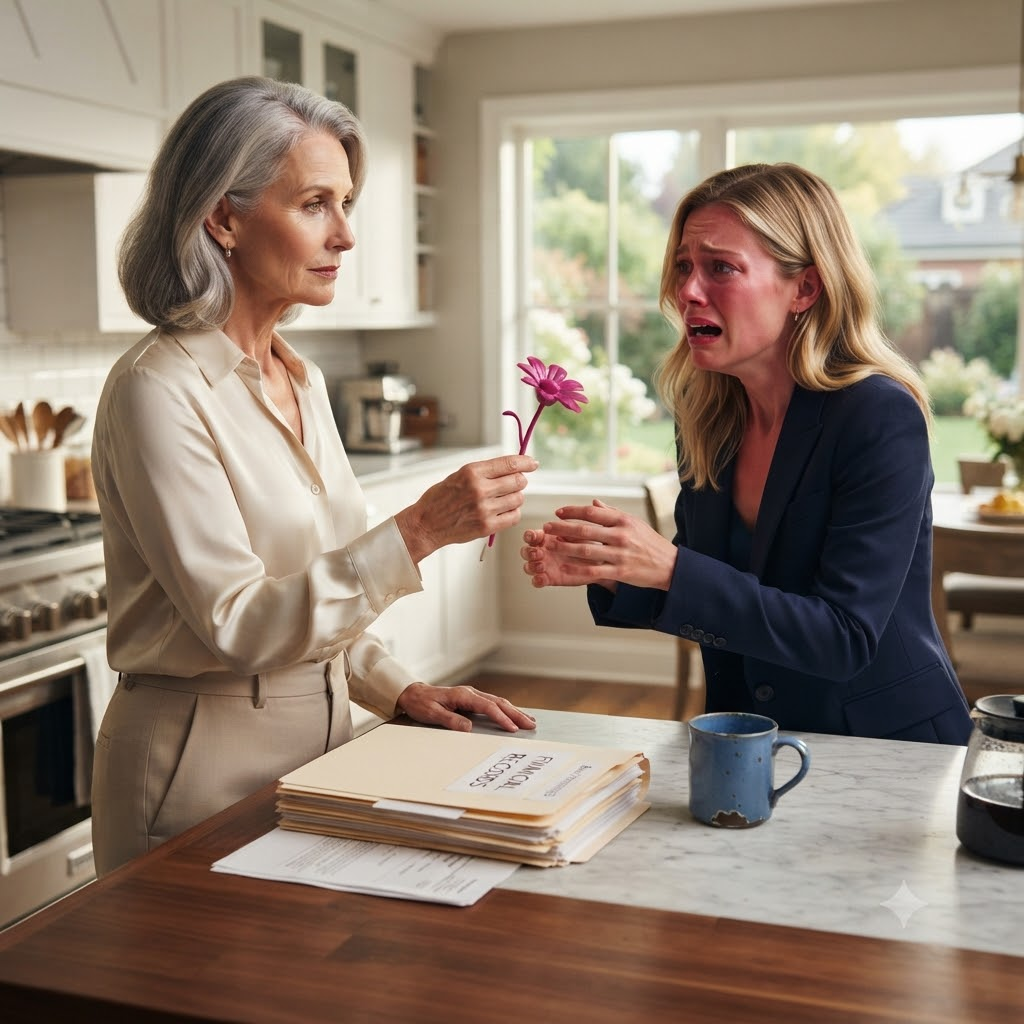
When she burst through the front door, she didn’t call out a greeting. She went straight to the kitchen, her face flushed, her eyes wild. “Give me the papers, Mom. Stop this nonsense. I’ll apologize for the flower. It was a joke, a stupid gift, I didn’t mean—”
“I know exactly what you meant,” I said, standing in the doorway of my study. I held the folder of bank statements in one hand. “You meant that I am someone who can be bought off with a piece of plastic and a polite nod. You meant that my life’s work was just a utility bill to be paid.”
“You’re being dramatic!” she cried, her voice cracking. “Preston and I, we have a future! You’re destroying our reputation!”
“No,” I said, stepping forward. “I am revealing the truth. Your reputation was built on my backbone. Without me, you are just people living a life you cannot afford. And that, Sloane, is not a failure on my part. It is a lesson on yours.”
I walked past her to the table and picked up the plastic flower. It felt lighter than it had yesterday. I held it out to her. “You forgot this yesterday. I thought you might want it back. It’s the only thing in this house that truly belongs to you.”
She stared at the flower, then at the folder in my hand, and for a fleeting second, the bravado shattered. She looked at me—not as a bank account, not as a source of funds, but as a woman who had once held her hand while she slept, who had traded her own dreams to ensure her daughter would never have to know the meaning of the word ‘enough’. She looked at me, and I saw the terror of a person who had never learned to stand on their own two feet.
“If you sell,” she whispered, the fight draining out of her, “they’ll take everything. The house, the cars, the status. I’ll have nothing.”
“You will have exactly what you created,” I said, feeling no malice, only a cold, crystalline clarity. “You will have yourself.”
I walked toward the front door, leaving the folders on the table—the records of a lifetime of sacrifice, now serving as a map for her to navigate her own reality. I stepped out into the garden, the air smelling of damp earth and coming rain. I didn’t look back to see if she had followed. I didn’t care if she was crying. For the first time in sixty-eight years, I wasn’t listening for the sound of a daughter’s approval or a husband’s praise. I was listening to the wind, to the silence, and to the sound of my own footsteps, walking toward a future that, at long last, didn’t have a price tag. I was finally, beautifully, unneeded. And as I reached the gate, I realized that was the most expensive gift I had ever received.