
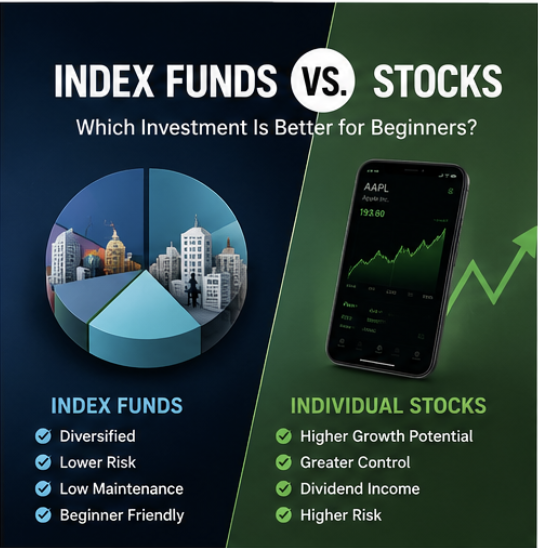
One of the biggest questions new investors face is whether they should invest in individual stocks or choose index funds.
Both investment options have helped millions of people build wealth over time, but they work differently and come with different levels of risk.
While some investors dream of finding the next big company and earning huge returns, others prefer a simpler strategy that requires less time and effort.
If you’re just starting your investment journey, understanding the differences between index funds and stocks can help you make smarter decisions and avoid costly mistakes.
In this guide, we’ll compare index funds and individual stocks, explain their advantages and disadvantages, and help you determine which option is best for beginners.
What Are Individual Stocks?
When you buy a stock, you’re purchasing ownership in a specific company.
Examples include:
- Apple
- Microsoft
- Amazon
- Nvidia
- Tesla
If the company performs well, its stock price may increase, allowing investors to earn profits.
However, if the company struggles, its share price may decline, leading to losses.
Individual stock investing allows investors to potentially achieve higher returns, but it also involves greater risk.
What Are Index Funds?
An index fund is a collection of many stocks bundled together into one investment.
Rather than buying shares of a single company, investors own small portions of hundreds or even thousands of companies.
Popular examples include:
- S&P 500 Index Funds
- Total Stock Market Funds
- Nasdaq 100 Funds
Because index funds are diversified, they reduce the impact of poor performance from any single company.
For this reason, many financial experts recommend index funds for beginners.
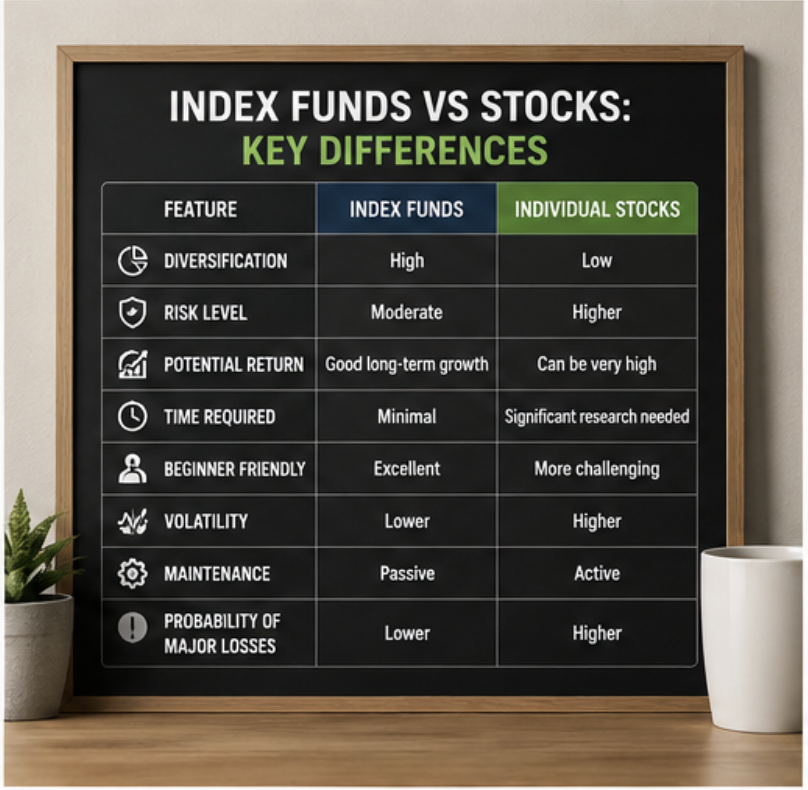
Index Funds vs Stocks: Key Differences
| Feature | Index Funds | Individual Stocks |
|---|---|---|
| Diversification | High | Low |
| Risk Level | Moderate | Higher |
| Potential Return | Good long-term growth | Can be very high |
| Time Required | Minimal | Significant research needed |
| Beginner Friendly | Excellent | More challenging |
| Volatility | Lower | Higher |
| Maintenance | Passive | Active |
| Probability of Major Losses | Lower | Higher |
Advantages of Investing in Index Funds
1. Instant Diversification
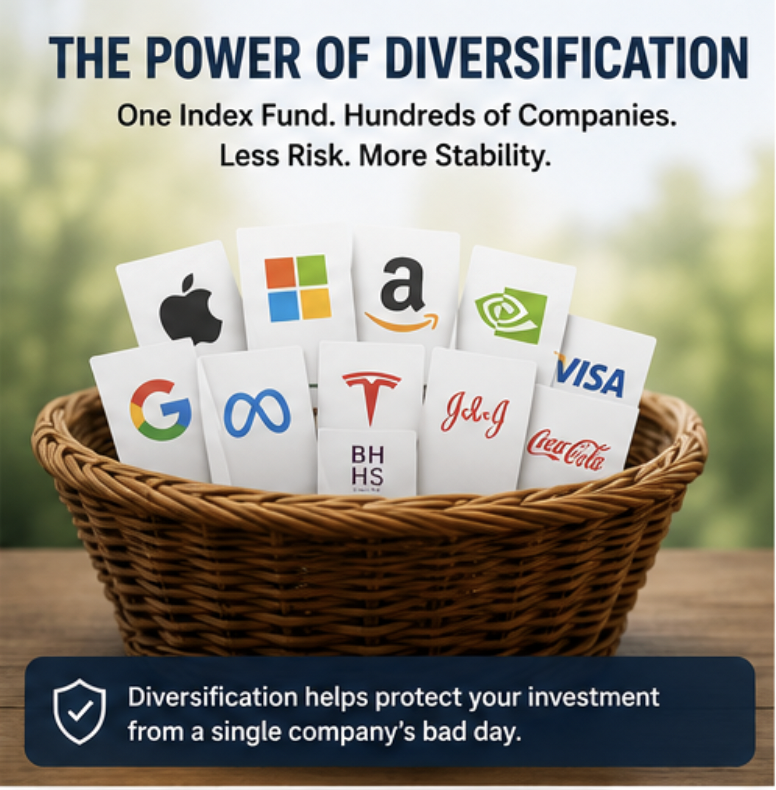
Buying one index fund gives you exposure to hundreds of companies.
This helps reduce risk because your investment isn’t dependent on the success of a single business
2. Lower Stress
With individual stocks, investors often worry about earnings reports, news, and market fluctuations.
Index funds require far less monitoring.
Many investors simply contribute regularly and hold their investments for decades.
3. Strong Historical Performance
Historically, the S&P 500 has generated average annual returns of around 8% to 10% over long periods.
Although past performance does not guarantee future results, this track record has made index investing one of the most popular wealth-building strategies.
4. Lower Costs
Most index funds have extremely low expense ratios.
Because they are passively managed, investors keep more of their returns over time.
Advantages of Investing in Individual Stocks
1. Higher Growth Potential
Some companies have delivered extraordinary returns.
For example, investors who purchased shares of Amazon or Nvidia many years ago experienced enormous gains.
Exceptional companies can significantly outperform the overall market.
2. Greater Control
Stock investors can choose companies they understand and believe in.
This allows investors to build portfolios that reflect their personal interests and convictions.
3. Dividend Income
Many companies distribute dividends to shareholders.
Dividend-paying stocks can provide an additional source of passive income.
Risks of Investing in Individual Stocks
While stocks can offer impressive returns, they also involve greater uncertainty.
Common risks include:
- Poor company performance
- Increased market volatility
- Economic downturns
- Management failures
- Industry disruptions
Even large companies can experience substantial declines.
History has shown that no company is guaranteed to succeed forever.
Why Many Experts Recommend Index Funds for Beginners
Legendary investor Warren Buffett has repeatedly suggested that most people are better off investing in low-cost index funds.

His reasoning is simple:
Most professional fund managers fail to consistently outperform the market over long periods.
Instead of trying to pick winning stocks, beginners may benefit more from:
- Regular investing
- Long-term thinking
- Diversification
- Keeping costs low
This approach removes much of the complexity associated with investing.
Can You Invest in Both?
Absolutely.
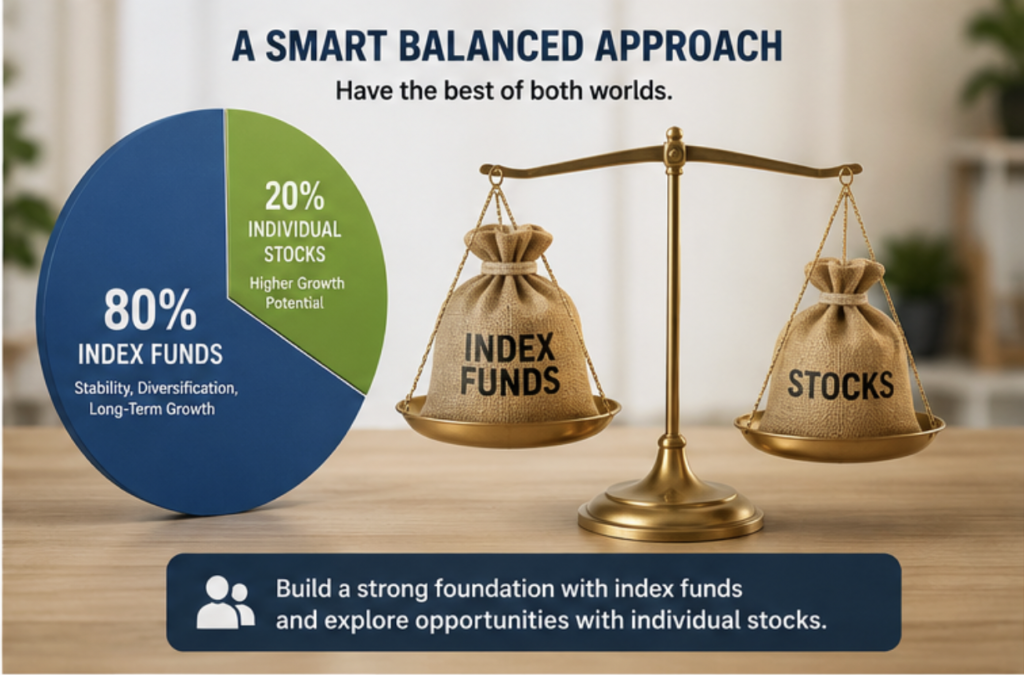
Many investors use a combination strategy.
For example:
80% Index Funds
Provides broad diversification and long-term stability.
20% Individual Stocks
Allows investors to pursue higher growth opportunities and learn about the market.
This balanced approach offers the advantages of both strategies while limiting excessive risk.
Which Option Is Better for Different Types of Investors?
| Investor Type | Better Choice |
|---|---|
| Complete Beginner | Index Funds |
| Busy Professionals | Index Funds |
| Long-Term Retirement Investors | Index Funds |
| Investors Who Enjoy Research | Stocks |
| Aggressive Investors | Stocks + Index Funds |
| Risk-Averse Investors | Index Funds |
| Experienced Investors | Combination Approach |
Common Mistakes Beginners Should Avoid
Trying to Get Rich Quickly
Investing is a long-term process.
Chasing “hot stocks” often leads to poor decisions.
Putting All Money Into One Company
Concentrating investments in a single stock creates unnecessary risk.
Diversification is one of the most powerful tools investors have.
Panic Selling During Market Declines
Markets naturally experience ups and downs.
Successful investors focus on long-term growth rather than short-term volatility.
Ignoring Fees
High investment costs can significantly reduce returns over time.
Low-cost index funds help maximize wealth accumulation.
Final Thoughts
Both index funds and individual stocks can help investors build wealth, but they serve different purposes.
For most beginners, index funds provide a simple, diversified, and low-stress way to start investing.
Individual stocks may offer higher returns, but they require more research, patience, and risk tolerance.
Many successful investors eventually combine both approaches, using index funds as the foundation of their portfolio while allocating a smaller portion to individual stocks.
The most important step isn’t choosing the perfect investment.
It’s getting started and remaining consistent over time.
Key Takeaways
- Index funds provide diversification and lower risk.
- Individual stocks offer greater growth potential but involve higher volatility.
- Most beginners are better suited to low-cost index funds.
- Combining index funds and stocks can create a balanced portfolio.
- Long-term consistency matters more than trying to predict short-term market movements.
Frequently Asked Questions
1. Are index funds safer than stocks?
Generally, yes. Index funds spread investments across many companies, reducing the impact of any single company’s poor performance.
2. Can beginners buy individual stocks?
Yes, but beginners should understand that stock investing requires research and carries higher risks.
3. How much money do I need to start investing?
Many brokers allow investors to start with as little as $10 to $100.
4. Can I become wealthy with index funds?
Many investors have built significant wealth through consistent long-term investing in index funds.
5. Should I choose stocks or index funds?
For most beginners, index funds are the better starting point because they provide diversification, simplicity, and lower risk.
About the Author
Daniel Hart
Daniel Hart is a personal finance and lifestyle writer at ViralStoryHub24. He focuses on investing, money management, and practical strategies that help readers build long-term financial security and improve their everyday lives. His goal is to make complex financial concepts easier to understand for beginners and individuals seeking greater financial confidence.